
How Much Does an EICR Cost in North London?
Honest, up-to-date pricing for landlord, homeowner and commercial EICR testing across Enfield, Haringey, Hackney, Brent, Barnet, Waltham Forest, Redbridge and Newham. Fixed-price from £180 for a 1-2 bed flat — real prices from real jobs, no estimates, no hidden costs, no marketing fluff.
A 1-2 bed flat EICR in North London costs £180. A 3-bed flat or 2-3 bed house: £230. 4+ bed: £280–£330.
I’m Rudi — 15+ years doing EICRs across north London. This is my honest, no-fluff guide to what an EICR actually costs in 2026.
1-2 bed flat: £180. 3-bed flat or 2-3 bed house (terrace / semi): £230. 4+ bed houses (detached / period villa): £280 – £330 depending on circuit count. HMO 5-6 bed (licensed): custom-quoted from £350 (per-letting-room testing). Commercial / shops / offices: custom-quoted from £280 after free site survey.
Every quote is fixed-price upfront. Price covers full inspection, written report with every observation coded (C1, C2, C3, FI), all measured test data, and 48-hour certificate turnaround.
The biggest factors that move price: property size + circuit count, HMO licensing requirements (per-letting-room testing adds 1-2 hours), property age (Victorian/Edwardian = more accessory sampling and access constraints), and combined certificates (EICR + alarm cert + emergency lighting bundled saves ~£80 vs separate visits).
Why £49 EICRs aren’t real EICRs
You’ll see lures like “EICR from £49”, “£75 landlord cert” or “£99 fixed price” across Google Ads and lead-gen sites. They’re not real EICRs. A genuine BS 7671 EICR for a 1-2 bed flat in north London is £180 minimum — and that’s the price every NICEIC-registered electrician you trust will quote.
Here’s what you don’t get for £49–£80:
- Insulation resistance testing on every circuit — most £49 EICRs sample one or two circuits and rubber-stamp the rest. BS 7671 requires every circuit tested at the consumer unit and at the furthest accessory.
- Earth fault loop impedance (Zs) at the furthest point of every circuit — this takes 60-90 seconds per accessory, so a real EICR on a 6-circuit flat takes 1.5-2.5 hours. £49 jobs are typically 25-35 minutes on site.
- Polarity, RCD trip-time and continuity tests — measured values must be on the certificate. Cheap certs frequently leave these blank or copy a generic value.
- Coded observations (C1, C2, C3, FI) with photo evidence — not a one-line “Satisfactory / Unsatisfactory” with no detail.
- Indemnity insurance and NICEIC backing — if a £49 cert turns out fraudulent, your tenant or buyer’s solicitor has no recourse against the certifier. Mortgage lenders and councils now flag suspicious low-cost certs and reject them.
The honest range for a real EICR in north London starts at £180 for a 1-2 bed flat, climbs to £230 for a 3-bed property, and sits at £280–£330 for 4+ bed houses. HMOs are from £350. If anyone offers materially less than £180, ask them to itemise the test list and time on site — they’ll usually decline.
Pricing by Property Size
Property size drives circuit count and how long the test takes. These prices are fixed-quote — no day rates, no surcharges. Every quote includes the full inspection, written report, all measured test data, and 48-hour certificate turnaround.
| Property Type | EICR Price | Time on Site |
|---|---|---|
| 1-2 bed flat (purpose-built or converted) | £180 | 1.5 – 2.5 hrs |
| 3-bed flat (purpose-built or converted) | £230 | 2.5 – 3.5 hrs |
| 2-3 bed house (terrace / semi) | £230 | 2.5 – 3.5 hrs |
| 4+ bed house (detached / period villa) | £280 – £330 | 4 – 5 hrs |
| HMO 5-6 bed (licensed) | Custom quote (from £350) | 4 – 6 hrs |
| Small commercial / shop / office | Custom quote (from £280) | 3 – 6 hrs |
All prices include the full BS 7671 inspection (consumer unit, every circuit dead-tested, accessory sampling), written report with every observation coded, all measured test data attached, and 48-hour certificate turnaround. Same standard certificate format whether you’re a homeowner or landlord.
Pricing by Service Tier
Same BS 7671 certificate, different test scopes. Residential EICR pricing scales with property size (more circuits, more accessories). HMO and commercial scopes are genuinely different — per-letting-room testing for HMOs, three-phase circuits for commercial — and quoted custom.
| Service Tier | Price | What’s Included |
|---|---|---|
| Residential EICR (1-2 bed flat) | £180 | Full BS 7671 inspection, every circuit tested, written report with all measured data, 48hr certificate |
| Residential EICR (3-bed flat / 2-3 bed house) | £230 | Same scope as above. Same certificate. Price reflects larger property + more circuits / accessories |
| Large Residential EICR (4+ bed house) | £280 – £330 | Detached / period villa with 8+ circuits, outbuildings, garden offices, EV chargers — scoped at survey |
| HMO EICR (5-6 bed licensed) | Custom quote (from £350) | Per-letting-room individual circuit testing (not sampled), AFDD scope verified, alarm cert combinable |
| Combined HMO Compliance Pack | Custom quote | EICR + EI4 emergency lighting + BS 5839-6 alarm cert bundled in one visit (saves ~£80 vs separate) |
| Commercial EICR (shops / offices) | Custom quote (from £280) | Three-phase or higher load, scoped per circuit count after free site survey |
| Same-day emergency turnaround | +£50 – £100 surcharge | Pre-completion / next-day-let urgent landlord requirements |
Pricing by Property Age
Older properties take longer to test (more access challenges, more accessory sampling) and have higher fail rates. Pricing reflects time on site, not the EICR being a different test.
| Property Age | Cost Premium vs Standard | Typical Issues / Notes |
|---|---|---|
| Modern (post-2008) | Standard pricing | Rewired or built to current 18th edition. Quick test, faster certificate. Mostly C3 observations only. |
| Post-war (1945-1985) | Standard pricing | Older PVC cable approaching end-of-life, missing RCD on shower circuits, ageing consumer units. Common C2 codes. |
| Pre-war / Victorian / Edwardian | +15 – 25% | Often retains rubber-cloth (VIR) wiring, ceramic fuse boxes, missing bonding. More accessibility issues with lath-and-plaster walls. |
| Period property conversions (multi-flat) | +25 – 40% | Per-flat sampling, shared neutrals between flats, undersized supply tails. Higher fail rate, more remedial work flagged. |
| HMO regardless of age | +30% | Per-letting-room testing (not sampled), AFDDs verified, alarm cert often combined. |
Residential vs HMO vs Commercial EICR
Three EICR scopes — same BS 7671 standard, different test depth. The price difference is real (HMOs need per-letting-room testing, commercial needs three-phase scope), not a packaging upcharge.
What Actually Affects EICR Cost
Beyond size and age, these are the property-specific variables that shift an EICR quote up or down. Most quote conversations come down to these factors.
HMO licensing scope
Per-letting-room circuit testing required for HMO licences. Adds £100-£175 vs sampled testing in a standard residential EICR.
Property age + access
Lath-and-plaster walls, original cornice, fragile period detail = more careful accessory sampling. +15-25% on Victorian/Edwardian.
Accessory count
Modern homes have 50% more sockets than 1960s spec. More accessories sampled = longer test time.
Combined cert bundles
EICR + alarm cert + emergency lighting bundled = £350 vs £430 separately (saves £80).
Same-day turnaround
Pre-completion / next-day-let urgent landlord requirements: +£50-£100 surcharge.
Solid floors / concealed runs
Cable routing through ceilings (post-war estates) takes longer than suspended-floor terraces.
Commercial three-phase
Shops, offices, small commercial scoped per circuit count — typically £280-£450.
Real North London EICR Cases
Anonymised real jobs from the past 12 months across our 8-borough coverage. Property type, scope, findings, final price, time on site — exactly as they happened.
EICR fail — half the consumer unit had no RCD protection (C2)
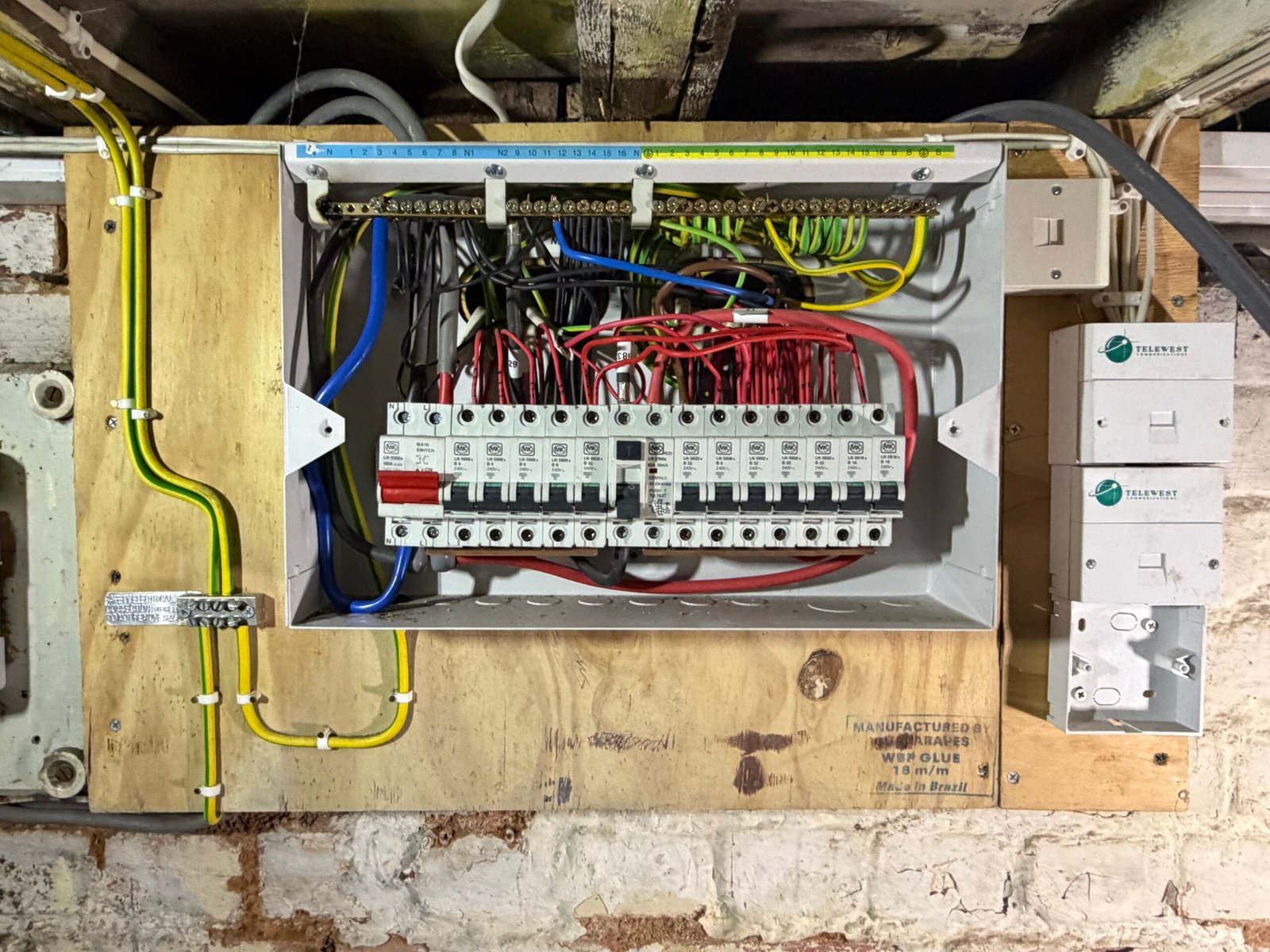
What we found: Older 16-way split-load consumer unit (mid-2000s vintage) where one of the two RCDs had been bypassed at some point — meaning half the circuits (kitchen ring, sockets, immersion) had no residual current protection at all. Automatic C2 fail under current 18th edition Amendment 2. Cable management above the board was also chaotic with red switched-lives bundled together — typical patch-job retrofit.
What we did: Issued the EICR with full test data and photos. Recommended consumer unit upgrade to a modern 14-way RCBO board with SPD (each circuit individually protected, full-installation RCD coverage). Customer authorised the remedial — completed in one day, certificate re-issued as satisfactory the same week.
Failed insulation resistance + no CPC on lighting circuits → full rewire
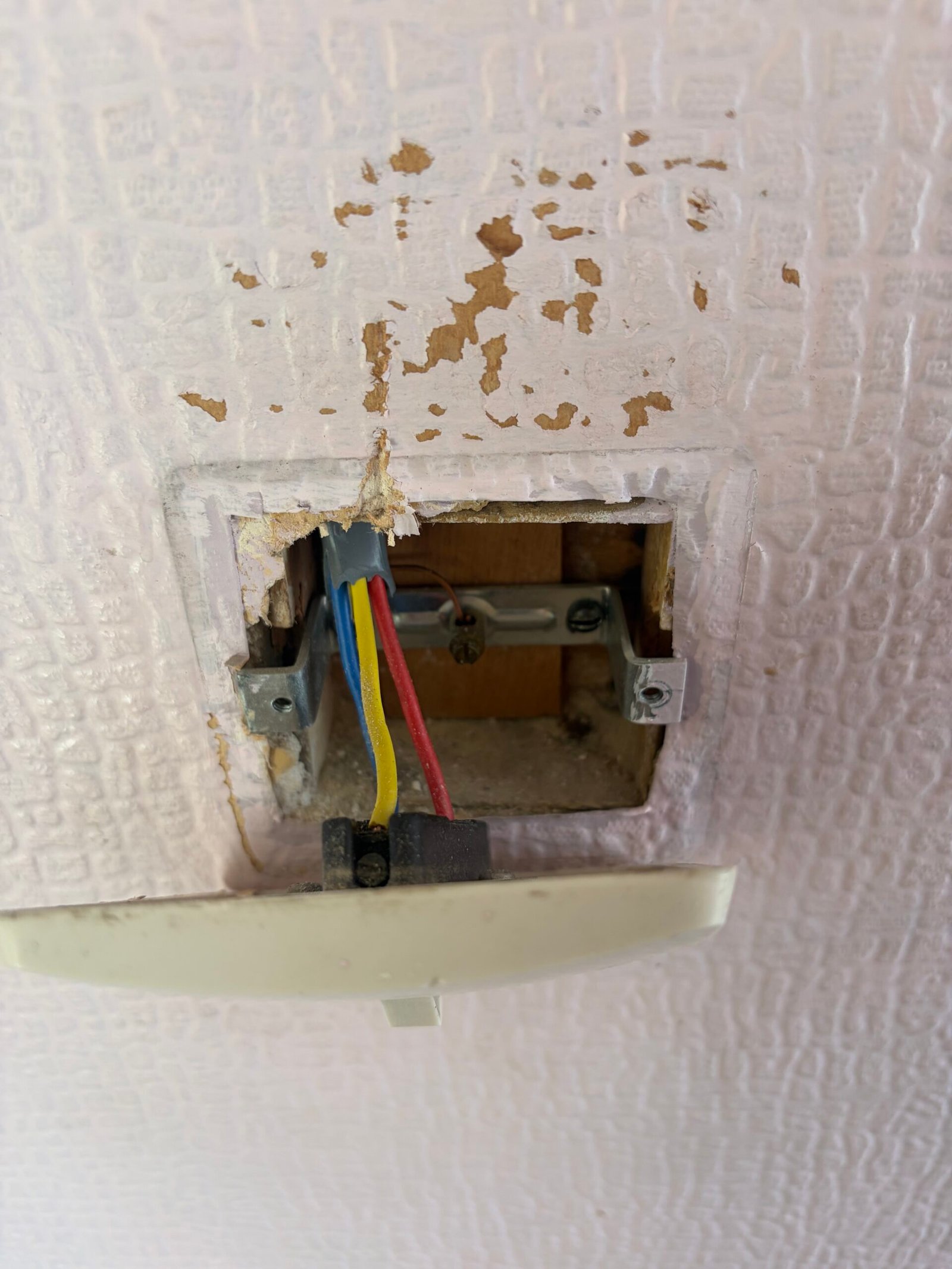
What we found: Old single-core cables with tinned-copper conductors on the lighting circuits (red/yellow/blue colour code from before the 2006 standardisation) — multiple readings under 0.5 MΩ on insulation resistance testing (well below the 1 MΩ minimum). Plus no CPC (Circuit Protective Conductor — i.e. earth) on the lighting circuits, meaning metal pendant fittings had no fault path to ground. Multiple C1 codes — automatic fail.
What we did: Quoted full rewire — every circuit replaced, new RCBO consumer unit, CPC throughout for proper earth on every fitting. A sample of the original cables was retained as evidence with the EICR file. Re-tested as satisfactory after rewire completion. Property handed back to the homeowner ready for decoration.
Commercial EICR — exposed copper, cable chaos, new RCBO board fitted
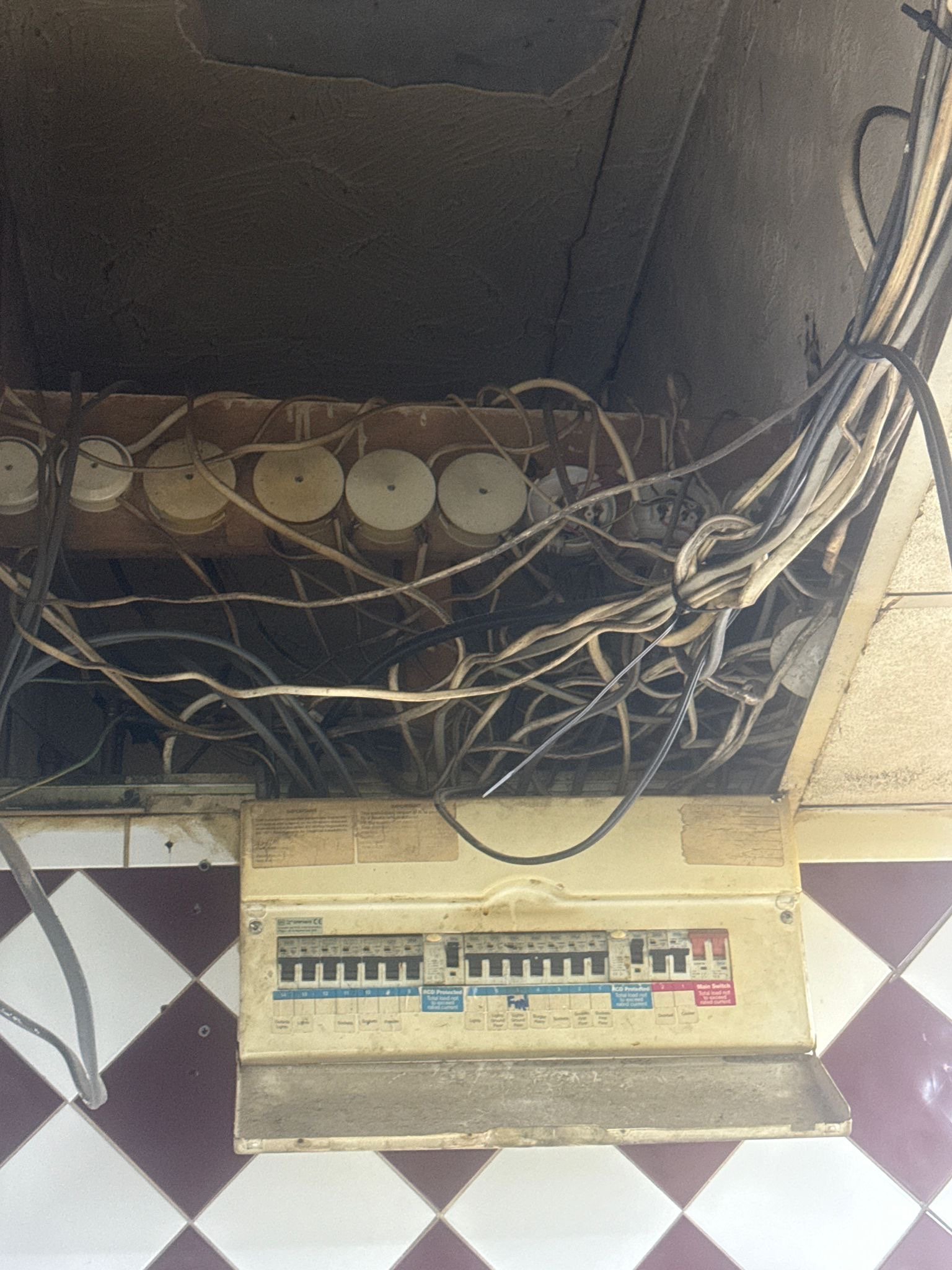
What we found: Older split-load consumer unit at the back of the shop, surrounded by a chaos of single-core cables in the ceiling void above. Multiple sections of cable with bare copper exposed where insulation had degraded or been damaged. C2 fail — exposed conductors are an immediate touch-shock risk in a public-access space. Cable management non-existent.
What we did: Replaced the consumer unit with a new RCBO board (each circuit independently protected, SPD fitted). Re-routed all cables through proper containment — installed a steel-trunking spine across the ceiling void, all cables re-clipped and secured, exposed copper terminated in maintenance-free junction boxes. Re-issued EICR as satisfactory. Shop kept trading — work scheduled outside opening hours.
High Zs at sockets — re-terminated installation + DNO fixed Ze on TNS supply
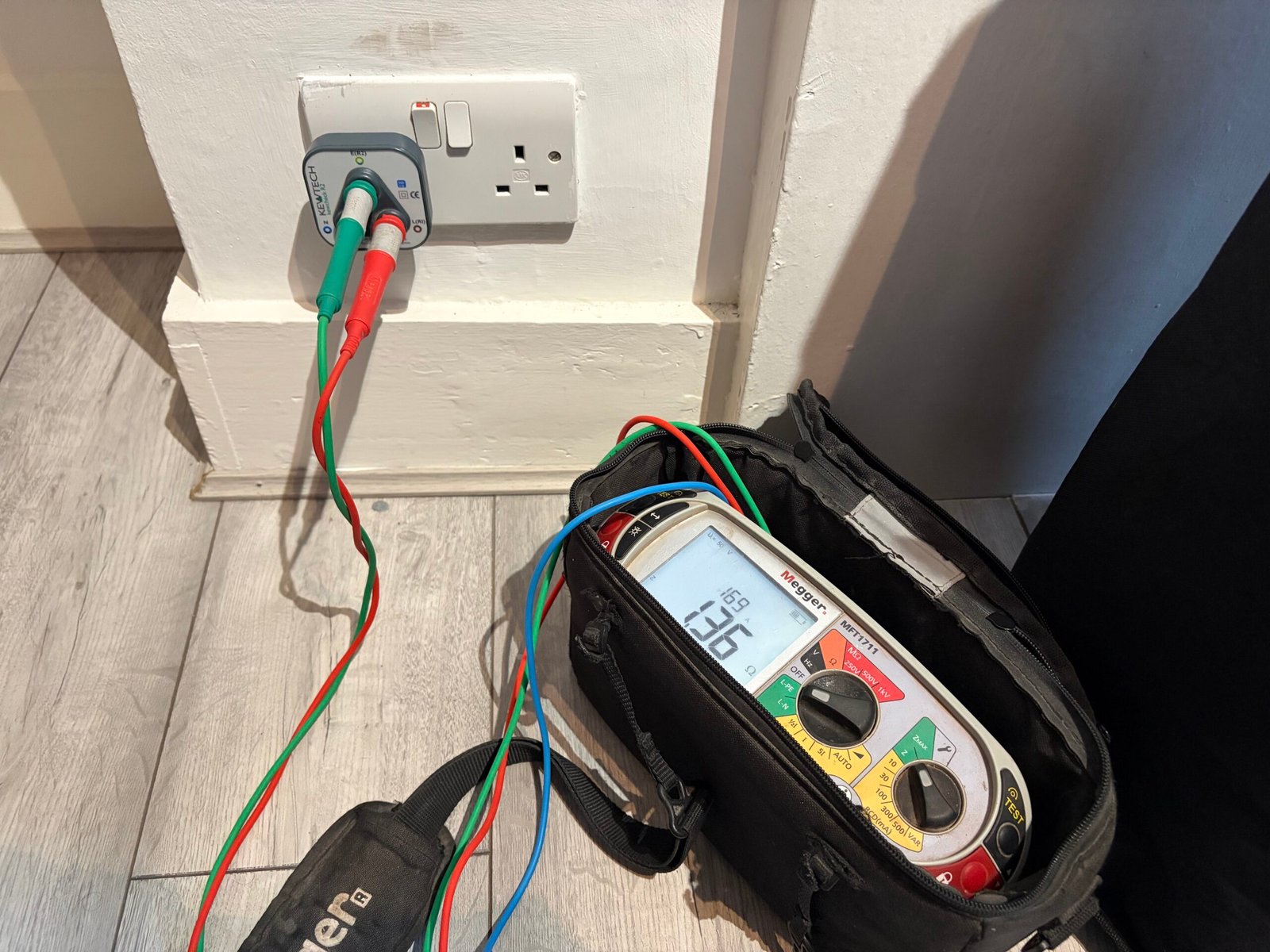
What we found: High Zs (earth-loop impedance) readings at multiple socket outlets — typically loose terminations at backbox connections (cables work loose over decades). Compounding this, the supply-side Ze (the impedance at the cutout, before the consumer unit) was 0.95 Ω — high for a TNS-earthed system, where you’d expect well under 0.5 Ω. The DNO’s supply earth had degraded over time.
What we did: Re-terminated every socket on the affected circuits — loose neutral and CPC connections at backboxes restored. Submitted formal request to UK Power Networks (the DNO) to inspect the supply earth — they attended within a week and improved the supply earth from 0.95 Ω down to 0.32 Ω. Both installation Zs and supply Ze brought within acceptable limits. EICR re-issued as satisfactory.
All case study customers consented to anonymised case use. Photos available on request.
Why EICR Prices Vary So Much
If you’ve seen EICR quotes from £49 to £350 for a 3-bed house, you’re not being fleeced — you’re seeing the difference between a real test and a tickbox certificate. Here’s why prices spread:
- £49-£75 EICRs are visual-only: a real EICR takes 3-4 hours of qualified electrician time. At £49 the labour cost alone doesn’t cover the time — meaning insulation resistance testing, earth-loop impedance per circuit, and RCD trip-time testing all get skipped. The certificate may say ‘satisfactory’ while real C2 failures hide in the wiring.
- Property size drives price: 1-2 bed flats are £180. 3-bed flats and 2-3 bed houses are £230. 4+ bed houses £280-£330. The certificate is the same BS 7671 standard form. The price differences are just labour time — more circuits to test, more accessories to sample.
- HMO per-letting-room testing: HMO EICRs cost more than standard residential EICRs because every circuit in every letting room is tested individually rather than sampled. This is a council licensing requirement, not an upsell — and it adds 1-2 hours of testing time per HMO.
- Bundled certificates save money: EICR + emergency lighting cert + alarm cert as a combined HMO compliance pack saves around £50-£80 vs separate visits. Always ask for the bundle if you’re an HMO landlord.
- Fixed price vs day rate: the cheapest quotes are usually day-rate-based, where the inspector races the clock to protect their margin — circuits get sampled instead of tested, photos get skipped, observations get under-coded. We quote fixed prices for the outcome: you get a real EICR with all the data, regardless of how long it takes us.
Our approach: we quote on a fixed-price basis after a free phone consultation. The price you see in the quote is the price you pay. Every circuit is tested. The certificate is issued within 48 hours of inspection.
EICR Cost FAQ
Direct answers to the cost questions we get most often during free phone consultations.
How much does an EICR cost in North London in 2026?
Our 2026 EICR pricing tiers:
• 1-2 bed flat: £180 (purpose-built or converted)
• 3-bed flat or 2-3 bed house (terrace / semi): £230
• 4+ bed house (detached / period villa): £280 – £330 depending on circuit count
• HMO 5-6 bed (licensed): custom-quoted from £350 (per-letting-room testing)
• Commercial / shops / offices: custom-quoted from £280 after free site survey
Every quote is fixed-price upfront — no day rates, no hidden surcharges. The price covers the full inspection, written report with every observation coded (C1, C2, C3, FI), all measured test data, and 48-hour certificate turnaround.
Why are some EICRs only £49 or £75? Are they real?
£49-£75 EICRs are a visual check, not a real EICR. A proper EICR takes 3-4 hours on a 3-bed property and tests every circuit individually. At £49/£75 the electrician can only afford to:
• Look at the consumer unit and a couple of sockets
• Skip insulation resistance tests (the part that catches actual fire risks)
• Skip earth-loop impedance per circuit
• Skip RCD trip-time testing
The certificate they hand you may say ‘satisfactory’ while real C2 failures hide. Worse, councils, surveyors and insurers can spot a no-test-data EICR — and reject it. Doing it cheap usually costs you twice (failed insurance claim, failed licensing inspection, bad survey on sale).
What does a £180 EICR actually include?
Our £180 standard EICR (1-2 bed flat) includes:
• Full inspection of consumer unit, earthing, main bonding
• Every circuit dead-tested (insulation resistance to 500V DC)
• Continuity testing on every circuit (R1+R2)
• Earth-loop impedance (Zs) on every circuit
• RCD trip times measured to BS 7671 thresholds
• Sample of accessories (sockets, switches, light fittings) opened and inspected
• Cable conditions assessed wherever accessible
• Full written report with every observation coded C1, C2, C3 or FI
• All measured test data attached to the certificate
• Standard BS 7671 certificate issued within 48 hours
What it does NOT include: appliance testing (PAT testing is separate, can be added) and smoke/heat alarm certification (BS 5839-6 cert separate, can be done same visit if needed).
How long is an EICR certificate valid for?
Standard EICR certificates are valid for 5 years. However:
• Some certificates specify shorter validity — properties with significant remedial work pending may be re-tested in 1-3 years per the inspecting electrician’s recommendation
• HMOs typically need 5-year cycles, but many councils require 3-year cycles under licensing conditions (Enfield, Haringey, Hackney, Newham additional licensing all enforce this)
• If your property has had major electrical work since the last EICR (rewire, new consumer unit, kitchen extension), a new EICR is recommended even if the existing certificate is in date
• For sales/conveyancing, the buyer’s solicitor will often ask for a fresh EICR if the existing one is over 3 years old
What if my EICR fails — how much do remedials cost (and what does each one actually involve)?
An EICR ‘fail’ (C1 or C2 codes) doesn’t mean a full rewire — it means specific remedials are needed. Typical remedial costs in North London with what each one actually involves:
• Missing RCD on shower / bathroom circuit (£180-£280) — swap the existing MCB for an RCBO that combines circuit protection with residual-current protection. Done at the consumer unit, ~1 hour.
• Borrowed-neutral fix between circuits (£250-£400) — older ‘shared neutral’ practice between bathroom and ground-floor circuits has to be re-wired so each circuit has its own neutral. ~2-3 hours of chase work.
• Main bonding to gas/water (£180-£260) — adds 10mm² protective bonding from the consumer unit earth bar to the gas meter and water main inlet. Required by current regs, often missing on pre-1990 installations.
• Degraded earth rod replacement (£200-£380) — TT-earthed properties: the earth rod buried outside has corroded, raising earth-loop impedance above safe limits. Replace with new rod + braid + connection.
• Partial recable (one zone — loft, bathroom) (£400-£900) — replaces perished VIR or PVC cable in one specific area without redoing the rest of the property. ~1-2 days.
• Consumer unit upgrade (RCBO with SPD) (£800-£1,200) — full replacement with modern 14-way RCBO board including surge protection device. Takes a day, includes new MCB protection per circuit.
• Full rewire (only ~1 in 8 EICR fails actually need this) (£4,500-£12,000+) — complete strip-out and replacement of every circuit. Reserved for properties with original VIR throughout, multiple zones failing, or beyond economical repair.
The C1 and C2 codes on your report tell you what’s legally required to fix. C3 codes are recommendations only, not legally required. We’ll quote the remedials at fixed price and re-issue the certificate as ‘satisfactory’ once the work is done.
What do the EICR codes (C1, C2, FI, C3) mean?
The codes on your EICR report tell you the severity of each finding. Only some of them require action:
• C1 (Danger Present) — immediate risk, usually a live conductor exposed or imminent shock hazard. Automatic FAIL on the report. We make safe on the day before we leave (e.g. isolate the dangerous circuit).
• C2 (Potentially Dangerous) — would become dangerous if a fault occurred or use changed. Automatic FAIL. Examples: missing RCD on a shower circuit, shared neutrals, undersized supply tails. Must be remediated for the report to become satisfactory.
• FI (Further Investigation) — safety can’t be confirmed without more checks. Treated as FAIL until resolved. Example: suspected fault that needs intrusive investigation.
• C3 (Improvement Recommended) — advisory only. Doesn’t fail the report. Examples: outdated consumer unit that’s still working, missing labels, single bedroom socket. Many landlords leave C3 codes alone — that’s allowed.
In plain terms: only C1, C2 and FI codes need fixing. C3 codes are notes for your records.
I just had a full rewire — do I still need an EICR?
No, in most cases. If you have a whole-installation Electrical Installation Certificate (EIC) less than 5 years old from a full rewire (not a partial), that EIC satisfies the legal landlord requirement instead of an EICR. The same applies to brand-new properties — the EIC issued at construction is valid for 5 years.
Important distinctions:
• Whole-installation EIC (full rewire / new build) — replaces the EICR for 5 years from issue.
• Partial EIC (e.g., new consumer unit only, single circuit added) — does NOT replace an EICR. You’ll still need an EICR for the rest of the property.
• Minor Works Certificate — small alterations only. Does NOT replace an EICR.
Make sure you keep the original EIC document (PDF and ideally a printed copy). Tenants and council inspectors can request to see it under selective licensing. If you’ve lost the EIC, you’ll need a fresh EICR.
What happens on the day of the EICR?
For a typical 1-3 bed property, allow 2-4 hours on site. Here’s what to expect:
• Power interruptions — we isolate circuits one at a time to test them. Short, planned cuts as we work through the consumer unit. We minimise downtime and restore power between tests.
• Save your work — anything important on PCs or servers should be saved before we start. Most modern fridges/freezers handle short cuts fine.
• Access — clear space around the consumer unit, sockets reachable, loft hatch accessible if applicable, outbuildings unlocked.
• Paperwork — have any previous EICR / EIC paperwork ready if you have it. Helps us flag changes since the last test.
• Tenanted properties — give us tenant contact details, alarm codes, and any access constraints in advance.
• Parking — sort residential bay, visitor permit, or pay-and-display nearby before we arrive. We don’t add parking surcharges to your bill.
• After the test — verbal summary on the day, written PDF report within 48 hours via email.
How do I count my circuits before getting a quote?
Knowing your circuit count helps us give a more accurate quote on the phone. It’s a 30-second check — no need to touch anything live.
• Find your consumer unit (fuse board) — usually in the hallway, under-stairs cupboard, utility room, garage or outside cupboard.
• Open the front flap (the hinged plastic cover). Don’t remove any covers or touch live parts — the flap is enough to see the breakers.
• Count the MCBs and RCBOs — these are the small final-circuit breakers (each with its own switch). Ignore the big main switch on the left and any RCD incomers.
• Note any dedicated heavy loads — cooker/hob, shower, immersion, boiler, EV charger and underfloor heating typically have their own circuit each.
• Don’t overcount — socket fronts, fused spurs and individual appliances are NOT separate circuits. They’re served by ring/radial mains that are.
• Include sub-boards (garage, garden room, loft conversion etc.) — count their circuits separately and let us know they exist.
Tell us your circuit count + property size on the call, and we’ll confirm your fixed price upfront — no surprises when we arrive.
Is it cheaper to combine an EICR with other landlord certificates?
Yes — combining certificates saves time and money for landlords. Bundled packs are custom-quoted after free phone consultation, but typical savings:
• EICR + EI4 Emergency Lighting Certificate (HMOs): bundled saves ~£50 vs separate visits
• EICR + BS 5839-6 Smoke Alarm Certificate (HMOs): bundled saves ~£50
• EICR + PAT Testing (furnished lets): combined for up to 10 appliances at a single visit
• Full HMO Compliance Pack (EICR + emergency lighting + alarm cert): bundled saves ~£80 vs separate
The biggest saving is on HMO compliance packs — Enfield, Hackney, Haringey, Newham licensing teams want to see all three certificates and accept them as one bundled pack. Mention HMO licensing on the call and we’ll give you the bundled price.
Do landlords need a different EICR than homeowners?
Same test, same certificate. There’s no separate ‘landlord version’ of an EICR — it’s the same BS 7671 inspection producing the same standard certificate. What differs is the legal duty around the certificate, not the certificate itself:
• Validity period stated: every EICR states validity (typically 5 years). For landlords this matters because you must keep it current under the Electrical Safety Standards in the Private Rented Sector Regs 2020.
• Provide to tenant within 28 days of the test. Legal duty for landlords. Homeowners don’t have this.
• Provide to council within 7 days if requested. Selective and additional licensing areas (Enfield, Haringey, Hackney, Newham, Brent, Waltham Forest, Redbridge, Barnet — most of north London) can ask. Homeowners not subject to this.
• HMO licensed properties need a different scope: per-letting-room circuit testing, emergency lighting cert, alarm cert. This IS a different test scope, and it costs more accordingly.
Bottom line: a landlord with a 1-2 bed flat pays the same £180 as a homeowner with the same flat. The price difference between scopes comes from the property (size, HMO status), not from being a landlord vs homeowner.
Do I need an EICR before selling or buying a house?
Selling: not legally required, but a current EICR with no major issues makes the sale smoother — surveyors and solicitors increasingly ask for one. If you have a fail, the buyer may negotiate the cost off the asking price (often more than the actual remedial cost).
Buying: not legally required either, but strongly recommended for any property over 10 years old or where the seller’s existing certificate is over 3 years old. The £180 EICR can save you from inheriting £2,000+ of remedial work that wasn’t disclosed.
Conveyancing solicitors increasingly request a current EICR as part of the buyer’s pre-exchange checks. If you’re the seller and your EICR is over 3 years old, a fresh one is worth getting before going to market.
Can the survey for the EICR be done on the phone, or do you need to visit?
For the EICR itself, we have to visit — every circuit needs to be physically tested, every accessory sampled. There’s no remote EICR.
However the quote can usually be confirmed on the phone in 5-10 minutes — we ask about property type, number of bedrooms, age of the consumer unit, whether it’s HMO licensed, and what triggered the request (landlord licence, pre-sale, EICR fail elsewhere). Based on those answers we can give you the fixed price upfront.
If the property is unusual (commercial, three-phase, listed period property) we’d offer a free pre-EICR site survey before quoting. Otherwise the phone call confirms the price, and you book the EICR slot.
Explore EICR by Borough
All 8 North London boroughs covered, plus the NL hub. Each borough page has local property-type guidance, real-job examples, and per-borough licensing details.
Ready for a fixed-price EICR quote?
Free phone consultation, fixed quote within 24 hours, BS 7671 certificate within 48 hours of inspection. I’m Rudi — qualified electrician, 15+ years on the tools across N London.