
Garden Office & Shed Electrics
Wood Green
Need safe, reliable power in a shed, garage, workshop or garden office? We plan the supply, cable route, sockets and lighting for the actual Wood Green property so the new space does not depend on extension leads or improvised wiring.
NICEIC Registered Electrician · 15+ Years Experience · Full Certification Included · 5-Star Rated on Google
Garden Room & Outbuilding Problems We Solve in Wood Green
These are the practical concerns we resolve before installing power, sockets or lighting outside the main property.
"Can I just run an extension lead from the house to my shed? Surely that's fine?"
It's one of the most common causes of shed fires and garden fatalities. Extension leads aren't designed for permanent outdoor use — they degrade, flood with moisture, and aren't protected against faults. A proper SWA armoured cable installation costs far less than the risk. We'll get it done safely and certified.
"I want sockets and lights out there — but I'm worried about it tripping my whole house."
We install a dedicated circuit from your main consumer unit installation with its own RCBO protection, so a fault in the shed cannot affect your house circuits. The outbuilding gets its own small consumer unit too — completely independent, properly earthed, and designed to handle whatever you plug in out there.
"The cable has to cross the garden — I don't want it dug up or looking a mess."
We either bury the SWA cable at the correct depth with warning tape above it, or clip it neatly along fences and walls using galvanised clips. Both methods are permanent, weatherproof, and tidy. We'll discuss both options during the free site visit and work around your garden however you need.
"Do I need to notify anyone? I don't want problems when I sell the house."
Yes — any new circuit requires Part P notification. As NICEIC registered electricians, we self-certify the work and notify Building Control on your behalf. You receive an Electrical Installation Certificate on completion, which your solicitor will ask for when you sell. We handle the paperwork, you keep the peace of mind.
Shed and Outbuilding Electrics in Wood Green N22
Wood Green has a dense mix of Victorian terraces and 1930s semis — garden offices, sheds, and outbuilding electrics are increasingly common in Wood Green N22 as homeowners convert outbuildings for home working. We carry armoured cable and all fittings on every van. We can also combine with a CCTV installation visit on the same day.
Most Wood Green outbuilding jobs involve a new dedicated circuit from the main consumer unit, SWA armoured cable run to the outbuilding, and a small consumer unit or fused spur inside. Typical installation takes a full day. We cover Wood Green as part of our wider shed & outbuilding electrics service across North London. For general electrical work in Wood Green, see our electrician Wood Green page.
Outbuilding electrics in Wood Green commonly extend to other work — consumer unit upgrades in Wood Green when the outbuilding circuit needs extra capacity or spare ways, outdoor lighting design in Wood Green for patios and pathways, CCTV in Wood Green for shed and garden security, and home network and Wi-Fi in Wood Green extension when there is a workshop or garden office.
What Our Customers Say About Us
Real reviews from homeowners in Wood Green N22. Live Google reviews below — for all 388+ reviews across Google, Checkatrade and MyBuilder, see our testimonials page →
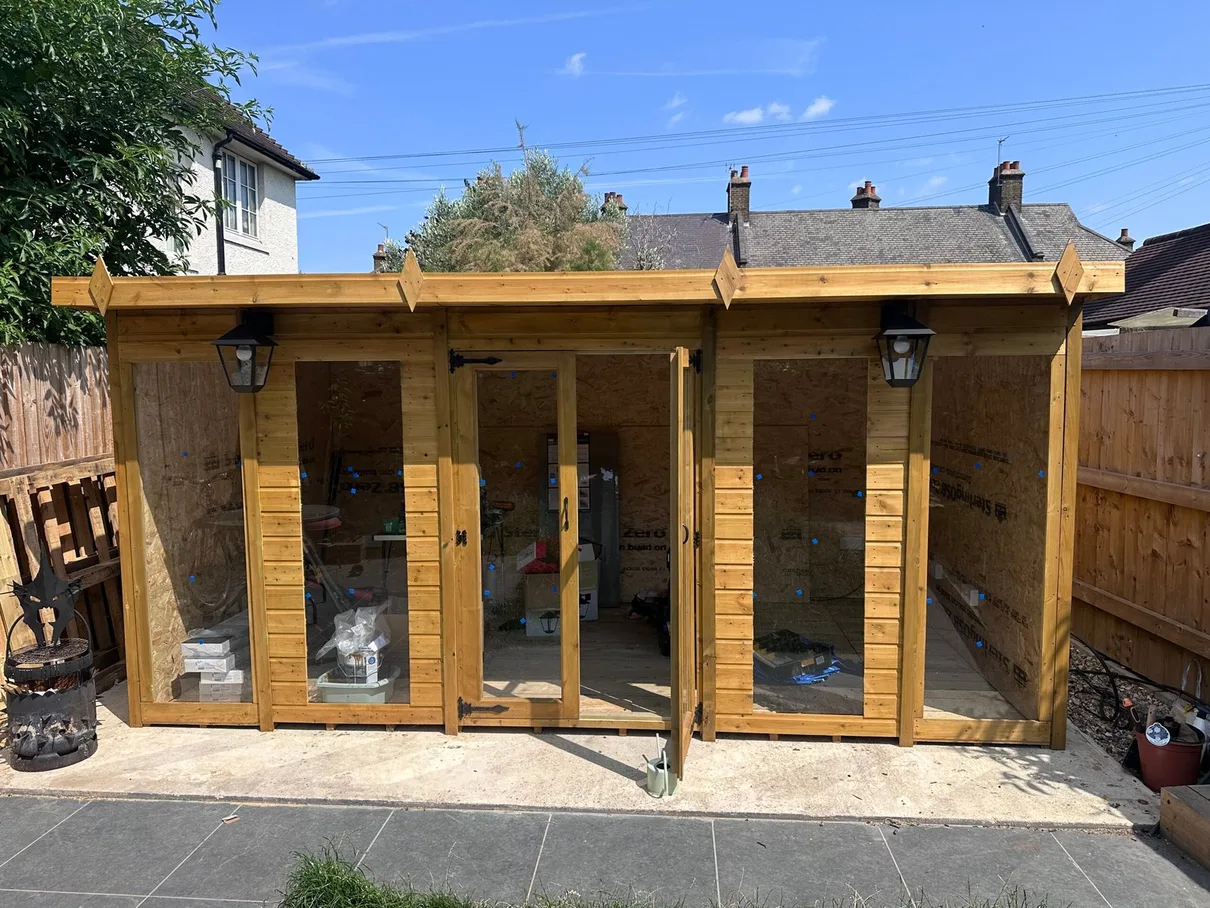
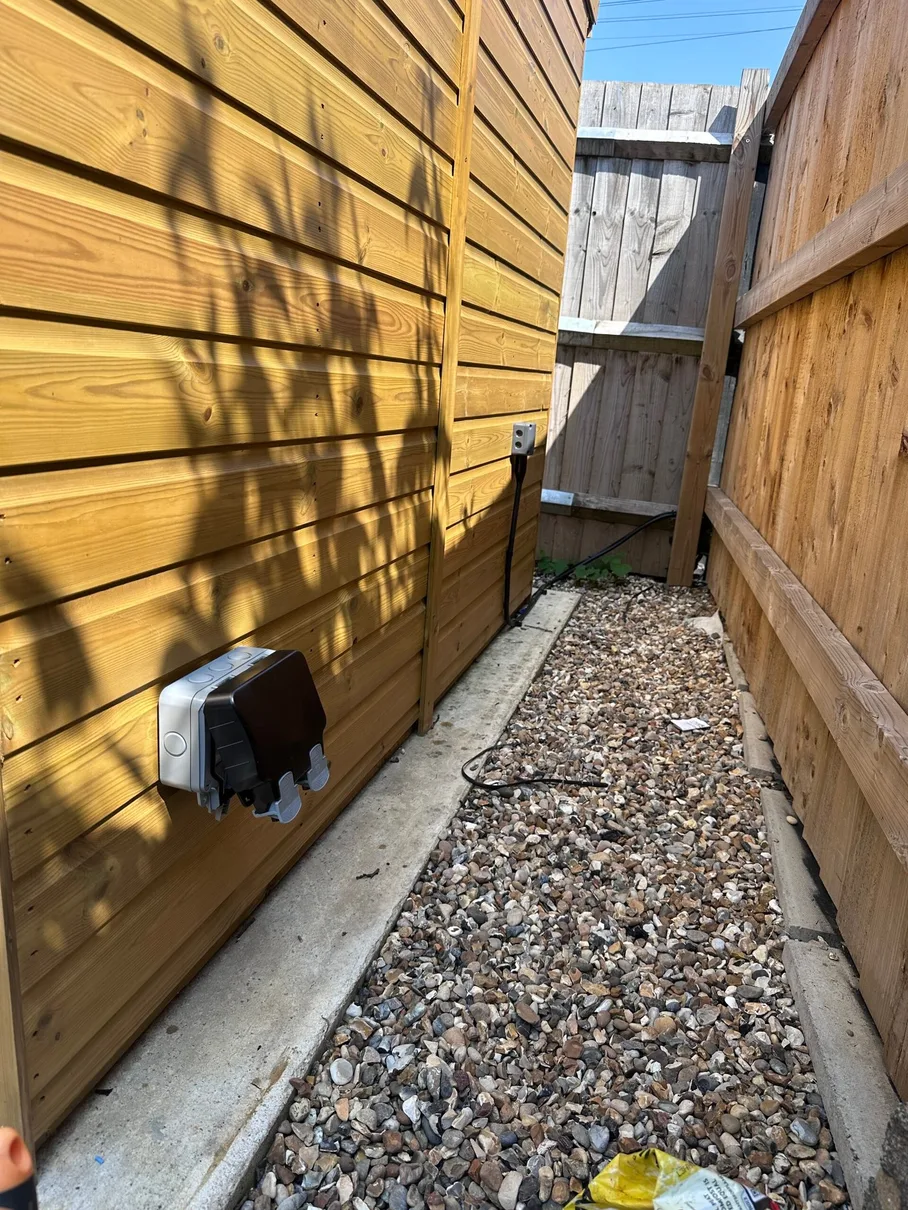
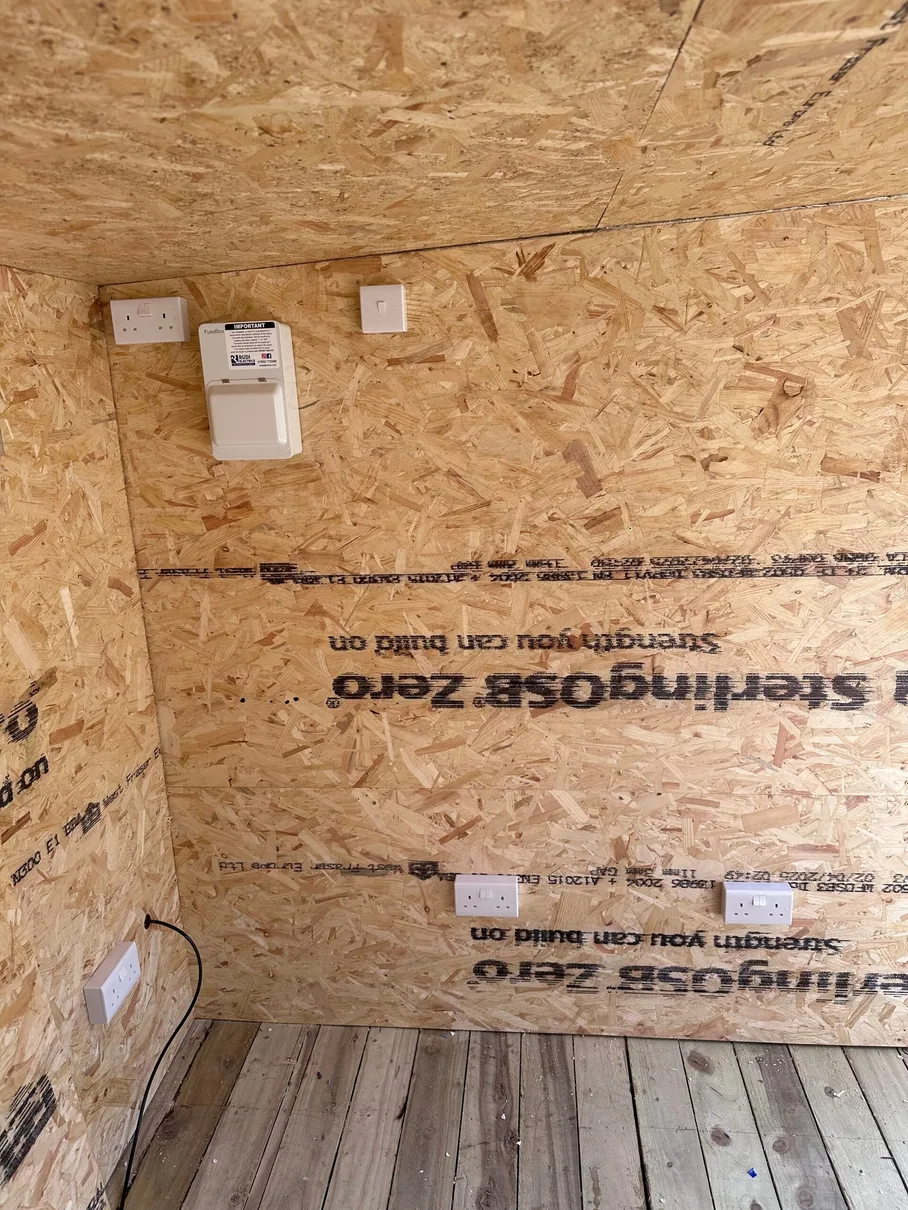
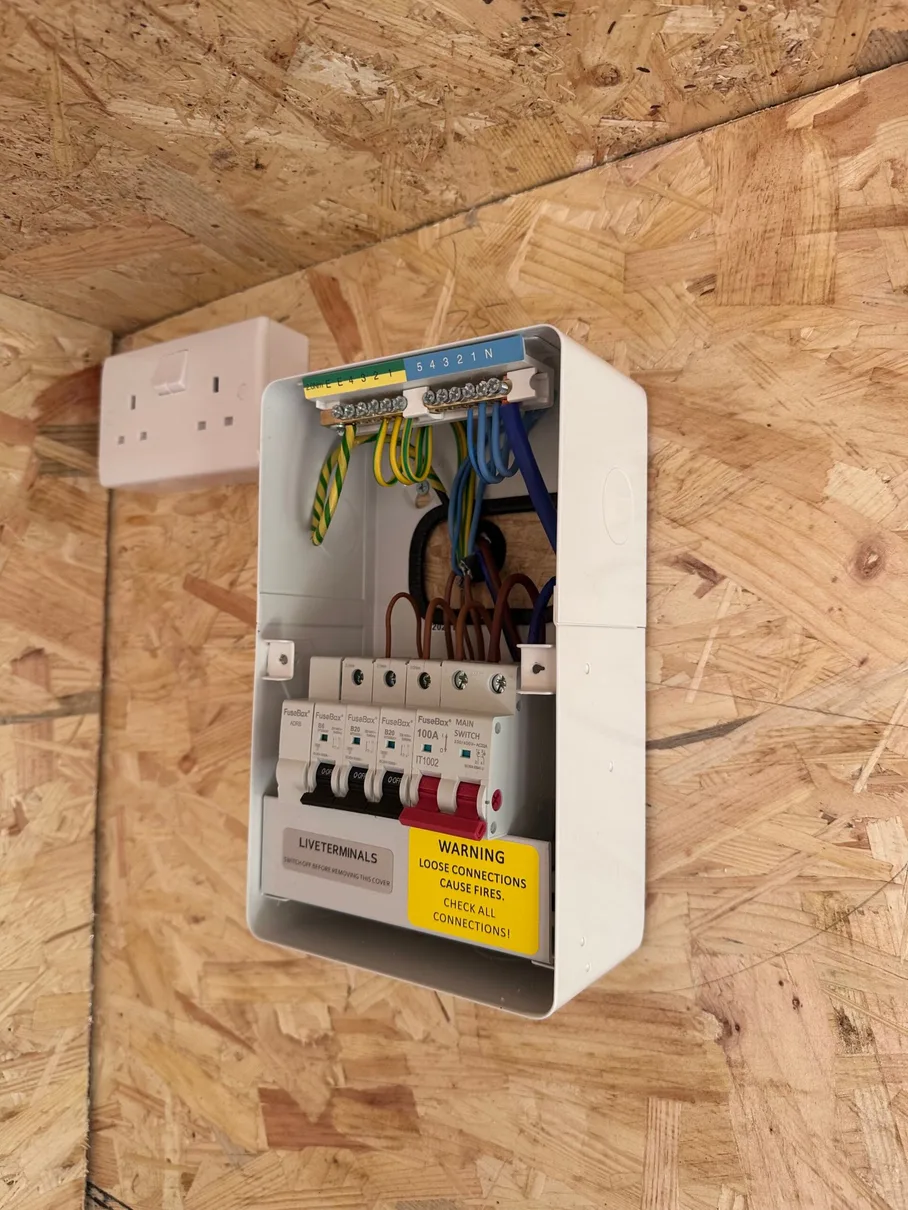
Shed and Outbuilding Electrics — Our Work
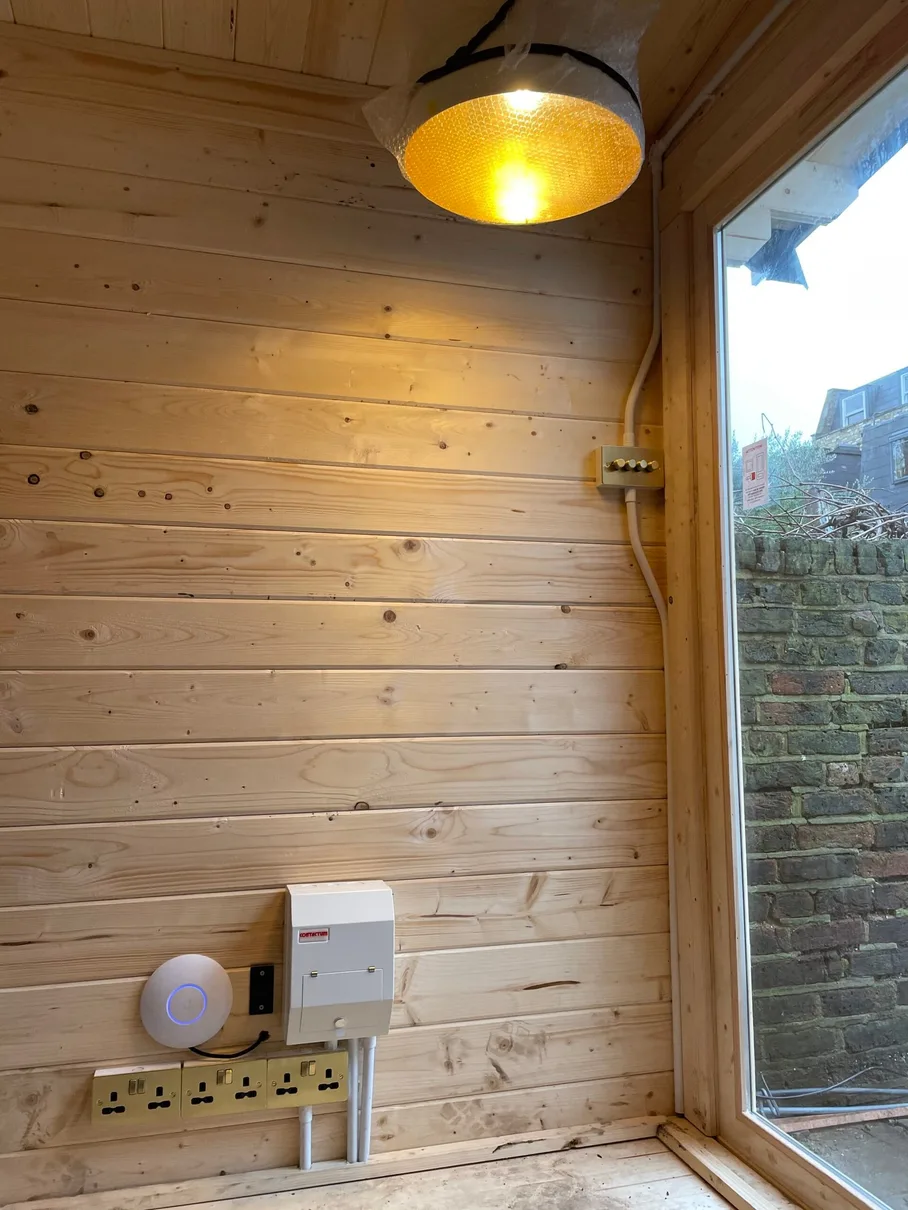
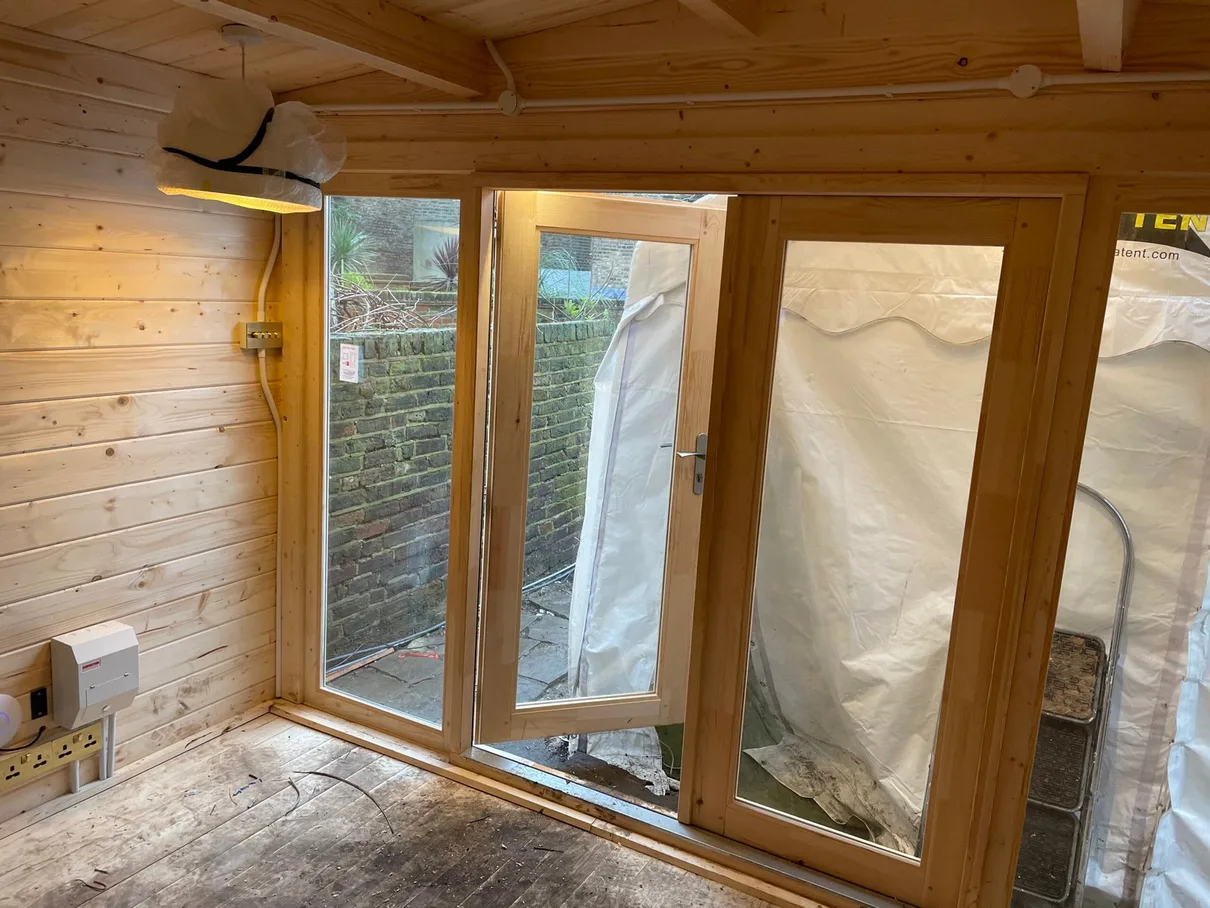
Real garden offices, sheds and outbuildings wired across North London — fully certified.
What Can We Install in Your Shed or Outbuilding?
From a basic light and socket to a fully wired garden office with heating and data points — here's what's possible with a professional outbuilding electrical installation in Wood Green N22.
Power & Sockets
Double sockets positioned where you actually need them — not just one on the back wall. We size the circuit for your intended use, whether that's a lawnmower and a workbench or a full garden office setup with monitors, standing desk, and a printer. Correct cable sizing for distance and load every time.
Lighting
LED batten lights for workshops and utility sheds, downlights for garden offices, and switched circuits so you can control zones independently. We fit the light fittings, run the wiring, and install the switches — leaving you with a properly lit space that's practical to use day and night.
Small Consumer Unit
Every outbuilding installation gets its own small consumer unit installation with RCD or RCBO protection — completely independent from your house circuits. A fault in the shed cannot trip your home. We install a TT earthing system (earth rod) where required and size the unit for any future circuits you might want to add.
Armoured Cable Supply
We run SWA (steel wire armoured) cable from your main house consumer unit to the outbuilding — either buried underground at the correct depth with warning tape, or clipped neatly along fences and walls. Never twin-and-earth or extension leads, which deteriorate outdoors and create serious safety risks.
Garden Office Fit-Out
Working from your garden office means you need it properly equipped — multiple double sockets, USB charging points, a dedicated circuit for a heater or air conditioning unit, data points for a wired internet connection, and appropriate lighting installation for a working environment. We design and install the full electrical fit-out in one visit.
Security & External Lighting
PIR floodlights covering the approach to the outbuilding, an external socket for power tools or a pressure washer, and a doorbell or intercom if needed. All outdoor fittings are IP65-rated for permanent external use. We can also tie the outbuilding into your existing CCTV installation system or add a new camera covering the area.
Not sure what your shed or outbuilding needs? We carry out a free site visit and advise on the right setup for your intended use — before any work is quoted or agreed.
How We Complete Your Shed or Outbuilding Installation
From the initial site visit to final certification — every outbuilding installation is planned, installed, and certified to BS 7671 with Part P notification handled on your behalf.
Free Site Visit
We visit to assess the cable route from your main consumer unit to the outbuilding, measure the distance, check what's already in place, and understand how you intend to use the space. We advise on the right setup — basic shed supply or full garden office fit-out — before any commitment is made.
Fixed Quote
You receive a written fixed-price quote covering armoured cable, consumer unit, earthing system, sockets, lighting, and all certification. We calculate the correct cable size for your run distance and load — and we tell you exactly what you're getting before you agree to anything.
Materials & Cable
We source the correct SWA armoured cable sized for your distance and load, the consumer unit, earth rod and clamp, IP-rated sockets and fittings for outdoor use, and all accessories. Everything is specified correctly — no undersized cable, no shortcuts on the earthing system.
Installation
Cable routed from the house consumer unit — buried underground with warning tape or clipped along fences. Earth rod driven, outbuilding consumer unit fitted and wired, sockets and lighting installed inside. New circuit added to your main board with its own RCBO protection. Typically completed in a single day.
Testing & Sign-Off
Full electrical testing to BS 7671 — insulation resistance, earth loop impedance, continuity, and RCD operation tests on the complete installation. Both the house circuit and the outbuilding consumer unit are tested and verified before we sign off. Nothing is left live until it passes.
Certification & Handover
You receive an Electrical Installation Certificate covering the full installation — essential for your insurance and required by your solicitor when you sell. As NICEIC registered electricians we notify Building Control on your behalf. We walk you through everything before we leave.
Ready to Get Power to Your Outbuilding?
Book a free site visit — most installations completed in a single day from £750
Book Your Free Site Visit
Tell us about your shed, garage, or garden office — we'll be back in touch After survey with a free fixed-price quote.
SWA Armoured Cable
Correctly sized steel wire armoured cable — buried underground or clipped to fences. Never extension leads or standard twin-and-earth outdoors.
Part P compliant, with Building Control notification where required
NICEIC registered electricians. We notify Building Control on your behalf and issue an Electrical Installation Certificate on completion.
Own Consumer Unit
Every outbuilding gets its own small consumer unit and TT earthing system — completely independent from your house circuits.
Fixed Price Quotes
From £750. The price is agreed after a free site visit — no extras on the day, no surprises.
Garden Office & Shed Electrics Wood Green — Across All Property Types
From Victorian terraces on Lordship Lane to HMO properties throughout N22 — we install shed and outbuilding electrics in Wood Green N22.
Swipe to explore all property types
Victorian & Edwardian Terraces
📍 Lordship Lane, Wolves Lane, Marlborough Road, Truro Road
Wood Green's dense terrace streets have rear gardens accessed through the house or side entry — cable routing to sheds and outbuildings requires careful planning. Long cable runs across narrow gardens, plus the need for buried armoured cable to avoid the lawnmower hazard.
Buried SWA armoured cable at 500mm depth from consumer unit to outbuilding. Dedicated RCBO-protected circuit — no more extension leads across the garden. Sub-board in shed with sockets and lighting. Most Wood Green terrace shed installations complete in half a day.
1930s–1950s Semis & Council Properties
📍 Noel Park Estate, White Hart Lane, Penshurst Road, Coburg Road
Wood Green semis and council properties often have outbuildings or lockup garages with no proper electrical supply — or informal wiring that hasn't been assessed for decades. Solid concrete paths and drives make armoured cable burial more complex but still achievable.
Armoured cable to outbuilding — we plan the route to minimise disruption to concrete paths where possible, or use a lance to pull cable under paths without cutting. Distribution board, sockets, and lighting installed inside. Part P compliant, with Building Control notification where required.
Flats & HMO Properties
📍 Wood Green Central, Heartlands development, Turnpike Lane, The Mall N22
HMO properties and flats in Wood Green sometimes have communal storage buildings that landlords want to improve. Supplying communal outbuildings requires agreement with all relevant parties and careful documentation of the supply and protection arrangements.
Communal outbuilding supply — we assess the supply source, agree the route and protection arrangements, and install correctly. All documentation provided including certification suitable for Haringey Council HMO licensing purposes.
Garden Offices & Extended Properties
📍 Throughout Wood Green N22 — garden offices, workshops, home studios
Garden offices have become increasingly popular in Wood Green N22. For full-time working you need more than a basic shed supply — multiple sockets, data connection, heating, and good lighting all require a properly planned installation.
Full garden office electrical installation — dedicated circuit, sub-board, ring circuit for power, LED lighting, armoured CAT6 for data, and heating circuit. Completed in one day. We also add other high-load equipment preparation at the same time if required.
Need outbuilding electrics in Wood Green?
Honest answers about SWA cable, sub-consumer units, Part P compliance documentation, and WFH garden office spec
Twelve straight answers from NICEIC-registered electricians. Anything missing — call 07932 772050.
Garden office / shed electrics cost in Wood Green N22 — what does the £750 starting price cover?
The £750 starting price covers a basic outbuilding electrics install: SWA armoured cable from the house (up to ~15m run with trench pre-dug or simple route), small consumer unit in the outbuilding, 1-2 double sockets, and 1 LED light fitting. Includes Part P Building Regulations Compliance Certificate and full testing.
Everything else is quoted after a free site survey:
- Standard garden office (sockets around the room, lighting, heater circuit, up to 25m run): mid-range
- Full WFH garden office (multiple sockets, lighting, heating, ethernet, security lights): higher
- Workshop / hot tub circuits: per spec
- Insulation + weatherproof coordination with builder: scoped per project
What changes the quote: distance from house to outbuilding, trench digging (DIY-dug saves money), cable size required, number of circuits, heater type, network/lighting scope, ground type (lawn vs paving vs driveway).
Why hire a qualified electrician for outbuilding work: outbuilding electrics is notifiable under Part P and must be certified — see Q4. We issue the Building Control sign-off paperwork.
12-month install warranty. One trip, fixed quote, no daily-rate creep.
How is power actually run from the house to the outbuilding? Trench depth, SWA cable, what's involved?
Standard process for Wood Green gardens:
1. SWA (steel wire armoured) cable runs from your house’s consumer unit (or a new RCBO) out to the outbuilding. Armoured because it’s buried — protects against spades, rodents, and ground movement.
2. Buried in a trench — minimum 500mm deep under lawn, 600mm under driveways or paths. Bedded on sand, covered with sand, then yellow electrical warning marker tape, then backfilled with soil or turf.
3. Cable enters via a glanded entry at the outbuilding wall, terminates into either a small consumer unit (sub-board) or a junction.
4. Inside the outbuilding — sockets, lighting, heating circuit, all run off the new sub-board.
Alternative routes when burial isn’t possible:
- Surface-clipped along a fence in PVC conduit (less tidy, OK for short runs)
- Through soffits + along the side wall (decorative, used for bridge-style outbuildings)
Trench digging: if you dig the trench yourself (DIY trench), you save labour cost. We do the cable run, terminations, and certification. Most Wood Green customers split the work this way.
Key BS 7671 detail: the cable must be the right size for the load AND the distance — see Q6 for sizing.
Does my shed / garden office need its own consumer unit, or can it run off the house?
Two paths, depends on load and distance:
Path A — Spur from the house (small loads, short distance)
- One radial circuit from your house consumer unit
- Suitable for: small shed with 1-2 sockets + a light, summerhouse for occasional use, garden lighting
- Limit: total load ~13A, distance ~10m
- Cheaper, simpler
Path B — Sub-CU in the outbuilding (proper, what we recommend for garden offices)
- SWA cable from house CU to a small consumer unit in the outbuilding
- Outbuilding CU has its own MCBs/RCBOs for sockets, lighting, heating, network
- Suitable for: WFH garden office, workshop, anywhere with 2+ circuits
- Easier to expand later (add more sockets, other high-load equipment, hot tub) without disturbing house wiring
- Each circuit individually protected — fault in shed doesn’t trip your kitchen
Our default recommendation: sub-CU in any outbuilding intended for permanent use. Small sub-board (4-6 way) in a discreet spot — under stairs, by the cable entry. Costs slightly more upfront, saves trouble for years.
Spur from the house only when the outbuilding is genuinely just a single-light-and-socket job.
Is electrical work to a shed or outbuilding notifiable under Part P Building Regs? Will you certify it?
Yes — outbuilding electrical work is NOTIFIABLE under Part P Building Regulations in England and Wales. This means:
The work must be:
- Carried out by a qualified electrician registered with a Competent Person Scheme (NICEIC, NAPIT, etc.) — that’s us — OR
- Pre-notified to your local Building Control before work starts, then inspected and signed off by them
What we provide as a NICEIC-registered installer:
- Building Regulations certificate (Part P) — issued via NICEIC, sent to your Building Control automatically
- Electrical Installation Certificate (EIC) — confirming the work meets BS 7671
- Test results — Earth Loop Impedance, RCD trip times, insulation resistance for every circuit installed
- Schedule of test results + circuit diagram
What this means for you:
- Insurance / mortgage compliant
- Sale-of-house ready (buyer’s solicitor will ask for certs)
- Legal — Part P non-compliance can be enforced by Building Control and can affect house sale
Common misunderstanding: people assume sheds are ‘just a shed’ and outside the regs. They’re not. Any new fixed circuit outdoors triggers notification. We supply the appropriate certificate for work that requires one.
WFH garden office spec — how many sockets, what lighting, heating for year-round use?
Standard WFH garden office spec we install:
Sockets — 4-6 double sockets minimum, distributed around the perimeter:
- 2 by the desk (computer, monitor, charger, lamp)
- 1 each on adjacent walls (printer, phone, secondary device)
- 1 outdoor IP66-rated socket (mower, garden tools, festoon lights)
- Optional: USB-C wall sockets for phones/laptops (no plugs needed)
Lighting — three layers:
- Main ceiling light (6-8 LED downlights at 4000K — cool white for daytime work, no glare on screens)
- Desk task light (separate switch, dimmable)
- Outside light over the door (PIR sensor for evening returns)
Heating — see Q7 for full breakdown. Quick answer: oil-filled radiator (cheap) or wall-mounted infrared panel (efficient) — both on a separate dedicated circuit so they don’t trip the office sockets.
Network — CAT6 ethernet drop from the house (way more reliable than WiFi to a building 10-20m away). See Q10.
Other WFH essentials we sometimes add:
- USB-C charging strip
- Smart switching (Shelly relay) for remote on/off when leaving the property
- Ceiling fan or Velux opener for summer ventilation
What size SWA cable do I need? Does the distance from the house matter (voltage drop)?
Yes — distance matters more than people realise. UK regulations (BS 7671) cap voltage drop at 5% for power circuits. Long runs need bigger cable.
Quick reference for Wood Green gardens:
- Up to 15m, 32A load: 6mm² SWA (suits a typical garden office with sockets + lighting + heating)
- 15-30m, 32A load: still 6mm² SWA in most cases — tight on voltage drop
- 30-50m, 32A load: step up to 10mm² SWA
- 40A load (other high-load equipment from outbuilding, hot tub, large workshop): 10mm² SWA from 15m+
- 63A load (small commercial workshop, multiple high-current circuits): 16mm² SWA
What gets the calculation wrong (and we see weekly):
- Cheap installer uses 4mm² for a 25m garden office run — voltage drop fails the EICR
- Cable buried in a longer ‘decorative’ route (under patio, around pond) — adds 5-10m unnoticed
- Hot tub or other high-load equipment bolted on later — original cable can’t handle the load
We size every cable using a BS 7671 calculator that accounts for installation method, ambient temp, grouping, and length. No guesswork.
For Wood Green gardens, the most common spec is 6mm² SWA at 32A, sub-CU in the outbuilding, spare capacity for a future other high-load equipment.
What heating works best in a garden office — oil-filled radiator, infrared panel, or convection heater?
Trade-offs by type:
Oil-filled radiator — slow to heat, but holds heat well. Cheap. Best budget option. Plug-in or hardwired with timer. Honest verdict: works fine, but slow morning warm-up.
Convection heater (panel heater on the wall) — fast warm-up, low purchase cost, but feels ‘dry’ and uses more electricity. Good as a top-up or secondary heater.
Infrared (IR) panel heater — heats objects (you, desk, walls) not the air. Very efficient, modern look, instant warm feel. Mid-price. Our most-recommended for WFH garden offices — silent, no air movement, low running cost. Wall-mounted, hardwired.
Electric underfloor heating — luxury option, retrofit possible during build. Very even heat. Only practical if you’re building or refurbing.
Worst option (don’t): plug-in fan heater. Eats electricity, dries the air, blows dust on your laptop, trips RCDs.
Summer cooling: if your garden office overheats in summer, address it through ventilation and shading — Velux roof window with rain sensor, trickle vents, external blinds, ceiling fan. (We don’t install air conditioning — for AC, you’d need a separate specialist.)
Our default for Wood Green WFH offices: wall-mounted infrared panel heater + a ceiling fan or Velux for summer ventilation.
Can you handle high-load circuits — hot tub, workshop power tools, and capacity for a future other high-load equipment?
Yes — high-current circuits in outbuildings are a regular Wood Green job. Each has specific requirements:
Hot tub — typically 32A dedicated circuit, on its own RCBO (Type A or Type B depending on the model). The tub MUST have a fault current path that’s RCD-protected to 30mA. We bond pipework, install the tub isolation switch (lockable for safety), test under load.
Workshop power tools — woodworking lathes, table saws, dust extractors often draw 13-16A continuously. We install dedicated 16A or 20A radials, with industrial-grade sockets where needed. Surge protection added because sawdust + motors = lots of inrush.
Welder / spot welder — 16A or 32A dedicated circuit, often on its own RCBO due to the high inrush.
For Wood Green outbuildings: we size the SWA cable from the assessed load, route and installation method, and discuss realistic future loads before the design is agreed. We don’t install the charge point itself — that’s a job for a dedicated other high-load equipment installer — but the supply capacity is ready when you need it.
Insulation and weatherproofing — how do they affect the electrical install? When should I coordinate?
Coordinate BEFORE first fix electrics. Insulation goes in BETWEEN the timber frame and the inner wall lining. Cable runs go INSIDE the insulation void (not through it).
What we plan around:
- Wall insulation thickness — Kingspan / Celotex is usually 80-100mm; we run cables in the void or in a service-cavity in front of the insulation
- Roof insulation — same as above, plus roof void may have lighting cable
- Floor insulation — we don’t run mains under the floor unless absolutely necessary (rodent + damage risk); usually keep mains cables in walls
- Vapour barrier — must not be punctured by cable holes. We use grommets and sealant at every cable entry
- Cold bridges — cable entries through the outer wall must be sealed against draught and damp
What goes wrong when this isn’t coordinated:
- Builder installs insulation then we have to chase cables through it (damages insulation, costs more)
- Cable entries leak air → cold spots, condensation, mould inside the wall
- Fixing points for sockets, switches, lights are blocked by insulation behind the lining
Our default approach: we work with your shed/garden office builder so first fix electrics goes in BEFORE insulation. Saves 30-40% on labour vs retrofit.
Can I get WiFi / network in my garden office? Same network as the house?
Yes — and we strongly recommend hardwired ethernet over WiFi for any garden office. Key approach:
- CAT6 ethernet runs alongside the SWA cable in the same trench (different conduit, different depth, but same dig)
- Wired access point in the outbuilding — same WiFi network/SSID as the house, your phone hands over without dropping
- No WiFi dropouts during Zoom calls (the #1 WFH frustration)
- Same network = same printer access, same NAS, same VPN
For Wood Green gardens: if the trench is being dug for SWA anyway, adding CAT6 is minimal extra work. Skipping it now and retrofitting later means another trench dig.
For garden offices with no trench (cable surface-clipped): wireless point-to-point bridge — directional antenna on house, matching antenna on outbuilding, gigabit speeds line-of-sight.
See our Home Network FAQ for the full networking-side angle: mesh WiFi, ethernet specs, point-to-point bridges, business-grade options.
Our default for WFH garden offices: CAT6 ethernet drop in the SWA trench + wired access point in the outbuilding. Reliable, fast, no WiFi dropouts.
What's the install process — trench, time, Part P Building Regulations Compliance Certificate, signed-off paperwork?
Typical install timeline for a garden office / shed install:
1. Free site survey — we walk the property, measure cable runs, identify trench routes, agree the design with you. Written, itemised quotation after the scope is confirmed.
2. Trench prep — either you dig it (saves labour) or we dig it (machine for long runs, hand-dig for short). Trench is 500-600mm deep, sand-bedded.
3. Cable run (~2-4 hours) — SWA cable laid in trench, sand and marker tape over, backfilled. Conduit through the building wall with proper sealing.
4. Sub-CU + first fix (~3-5 hours) — outbuilding consumer unit fitted, circuits run to socket positions, light positions, heater positions.
5. Second fix (~2-3 hours, after any plasterboard) — sockets, switches, light fittings installed, all tested under load.
6. Commissioning + paperwork (~1 hour):
- Building Regulations certificate (Part P) issued via NICEIC, sent to Building Control automatically
- Electrical Installation Certificate (EIC)
- Test results — earth loop, RCD trip times, insulation resistance
- Walk-through with you before we leave
Total time: 1-2 days for a typical garden office, longer for workshops or hot tub installs.
12-month install warranty: if anything we installed stops working within the first year, ring us and we’ll come back at no extra charge. After 12 months, our standard £100 callout applies. Most issues troubleshoot remotely first.
Can I start with basic power and add more later — sockets, lighting, second outbuilding?
Yes — the trick is to spec the SWA cable from day one to handle future load. What we plan for:
- Cable headroom — we install 6mm² SWA at minimum even when the initial spec is 16A; gives you room for an other high-load equipment, hot tub, or workshop later without re-trenching
- Sub-CU with spare ways — 4-way or 6-way consumer unit even if you only have 2 circuits today; future circuits just plug in
- Conduit + draw rope — small spare conduit alongside the SWA cable means future cables (network, low-voltage, second cable run) can be pulled through without re-digging
Common upgrade paths we see:
- Year 1: garden office with sockets + lighting + heating
- Year 2: add an outdoor IP66 socket, garden lighting on a dusk-til-dawn timer
- Year 3: hot tub with dedicated 32A circuit
- Year 4: other high-load equipment off the outbuilding (if drive is closer to outbuilding than house)
- Year 5: second outbuilding (potting shed, summerhouse) on a spur from the first
For Wood Green gardens with limited cable routes: the first install is the biggest bottleneck. Get the SWA spec right once, expand cheaply forever. We always tell customers what they could add later before we quote.
Need power to your Shed or Garden Office in Wood Green?
Shed and outbuilding electrical installations in Wood Green N22 and surrounding North London areas including Edmonton, Enfield, Palmers Green, Southgate, Wood Green, Winchmore Hill, Chingford, and more. Free site visit, fixed prices, fully certified.