✓NICEIC Registered · D609991✓Part P & Building Regulations✓Fully insured · 12-month guarantee✓8 boroughs across North London
✓NICEIC Registered · D609991✓Part P & Building Regulations✓Fully insured · 12-month guarantee✓8 boroughs across North London
Consumer unit replacement · Winchmore Hill N21
Consumer Unit Upgrade Winchmore Hill
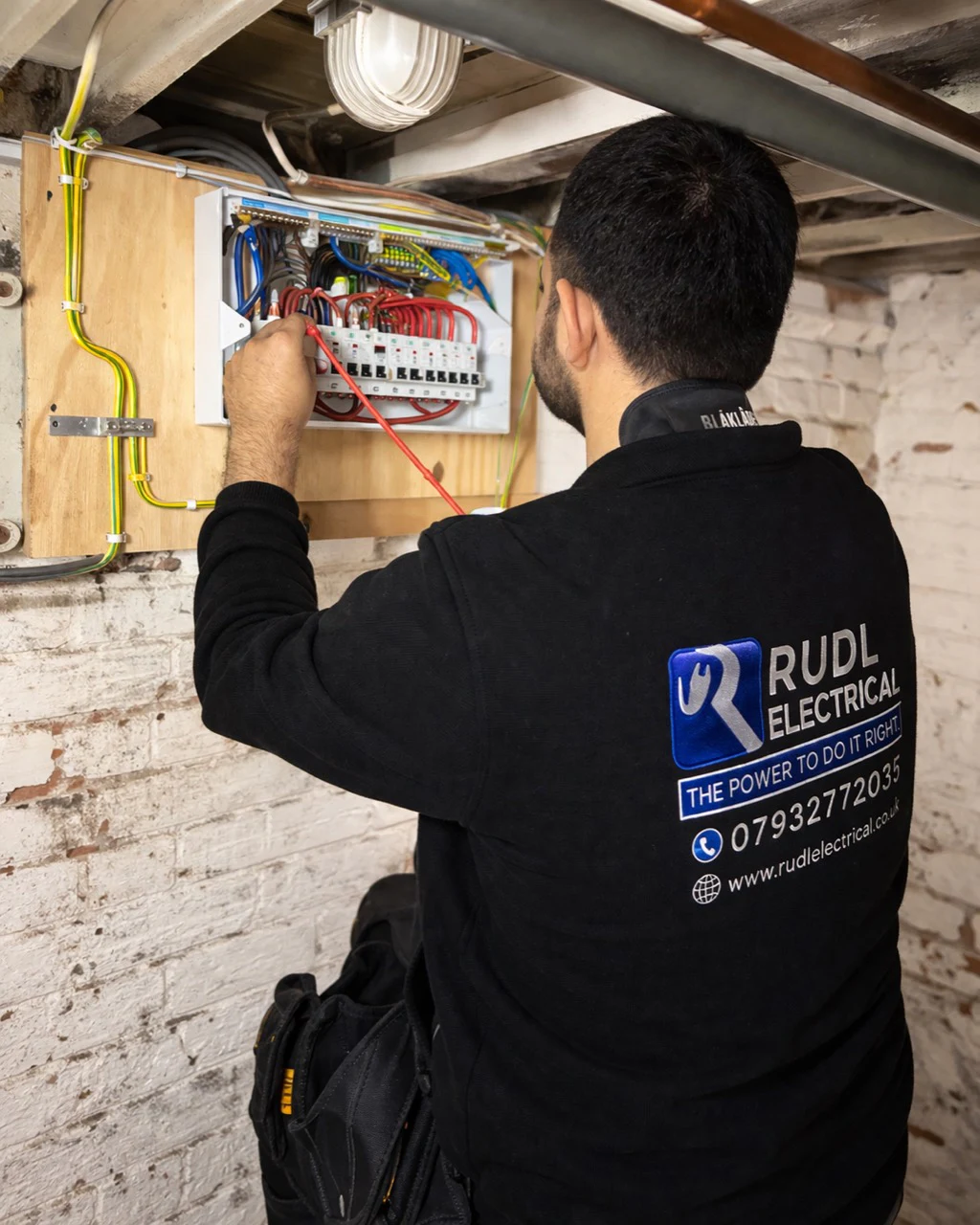
Old fuse box, repeated tripping or not enough modern protection in Winchmore Hill? We test the existing circuits first and tailor the board design to multi-storey period homes and loft offices & upper bedrooms, explaining any faults before replacement.
Consumer unit replacement from£800Final quotation depends on circuit count, existing condition, access and any required remedial work.
The standard brought to Winchmore HillA tested circuit schedule, coordinated protection and a handover that explains the finished Winchmore Hill installation.
North London service for Winchmore Hill N21
Local context should create a better survey.
Rudi Electrics is NICEIC registered under D609991. We use the property context around Winchmore Hill to prepare the right questions, while inspection and circuit testing decide the equipment and scope.
NICEICRegistered D609991
BS 7671Testing and certification
Part PNotification where required
12 monthsWorkmanship guarantee
What Our Customers Say About Us
Real reviews from homeowners and landlords across Winchmore Hill and the wider London Borough of Enfield. Live Google reviews below — for all reviews across platforms, see our testimonials page →
Your Fuse Box Upgrade Worries Answered in Winchmore Hill
The useful questions are about disruption, faults, access and the finished result. Here is what we check and agree before installation.
Explore the four questions01 / 04
01
Will replacing my fuse box make a mess in my home?
We protect the area around the existing board and keep the work centred there wherever possible. For Edwardian and early 20th century properties around Church Hill, Vicars Moor Lane, Compton Road, Highfield Road, The Grange, the survey records any tight enclosure position, visible cable casing or making-good that should be agreed before work starts.
02
Will I be left without power for days?
No. We usually aim to complete the main replacement work and restore power within 3–4 hours. Where the “Loft Offices and Upper Bedrooms” context affects 1930s detached and semi-detached homes around Broad Walk, Hoppers Road, Manor Road, Wades Hill, Firs Lane, the shutdown plan also allows for access, circuit identification and any fault that would prevent safe reconnection.
03
What will the new fuse box look like?
We explain the likely metal enclosure size and position before the visit. For village centre flats and conversions around Winchmore Hill Broadway, Station Road, Green Dragon Lane, The Village, the finished schedule identifies the circuits clearly and distinguishes genuine spare capacity from ways reserved for a specifically agreed future load.
04
What happens if testing finds an existing fault?
Testing connected with the “Garden Rooms on Deeper Plots” context can reveal a fault the old board did not make obvious. At extended properties and garden rooms around loft conversions, rear extensions, garden offices, we show the relevant result and keep repair work outside the agreed replacement price until the customer authorises it.
One address-specific scope for Winchmore Hill N21.The quotation records the board, testing, expected access and how an existing fault would be handled before extra work is authorised.
Six signs to look out for
Six signs your consumer unit may need replacing.
These signs can mean a fuse box in Winchmore Hill needs attention. Inspection and testing confirm whether replacement is necessary or a smaller repair is enough.
Swipe through the warning signs ← →
01Priority
Protection will not stay reset
Repeated operation in a Winchmore Hill property points towards a circuit or connected-equipment fault. We identify the affected part before deciding what the board needs.
02Priority
Heat, smell or discolouration
Warmth, scorching or a burning-plastic smell around the fuse box needs prompt attention. Reduce demand where safe and contact us rather than repeatedly resetting it.
03
Older circuits lack RCD protection
Age and appearance are useful clues, but the Winchmore Hill installation still needs its protective arrangement and connected circuits checked before an upgrade is recommended.
04
An EICR records a board issue
Send the full report so the observation, classification and recorded results can be reviewed. The necessary remedy may be narrower than a complete replacement.
05
The property has gained new loads
Garden Rooms on Deeper Plots can leave the present circuit schedule behind the way the property is now used. We check the verified load and capacity rather than treating spare ways as unlimited provision.
06
Labels no longer match the rooms
1930s Detached & Semi-Detached may have been altered since the existing fuse board was fitted. Circuit identification is part of the work, not a label copied from the old enclosure.
Clear scope before installation
What the £800 starting price includes.
In Winchmore Hill, a straightforward replacement with clear working access starts at £800. The written quotation confirms the board, circuit count, testing and any separate repairs before installation.
01
Surveyed before specification
Supply, earthing, bonding, circuit count and existing protection are checked before products are chosen.
02
Board and protection fitted
The board, RCBOs and surge protection are fitted to the agreed written scope.
03
Tested, labelled and certified
Every transferred circuit is identified, tested and labelled, with the applicable certificate.
04
Unexpected faults kept separate
Existing defects are shown separately and approved before any extra repair begins.
Rudi Electrics installation evidence
Real consumer unit work from the North London homes we serve.
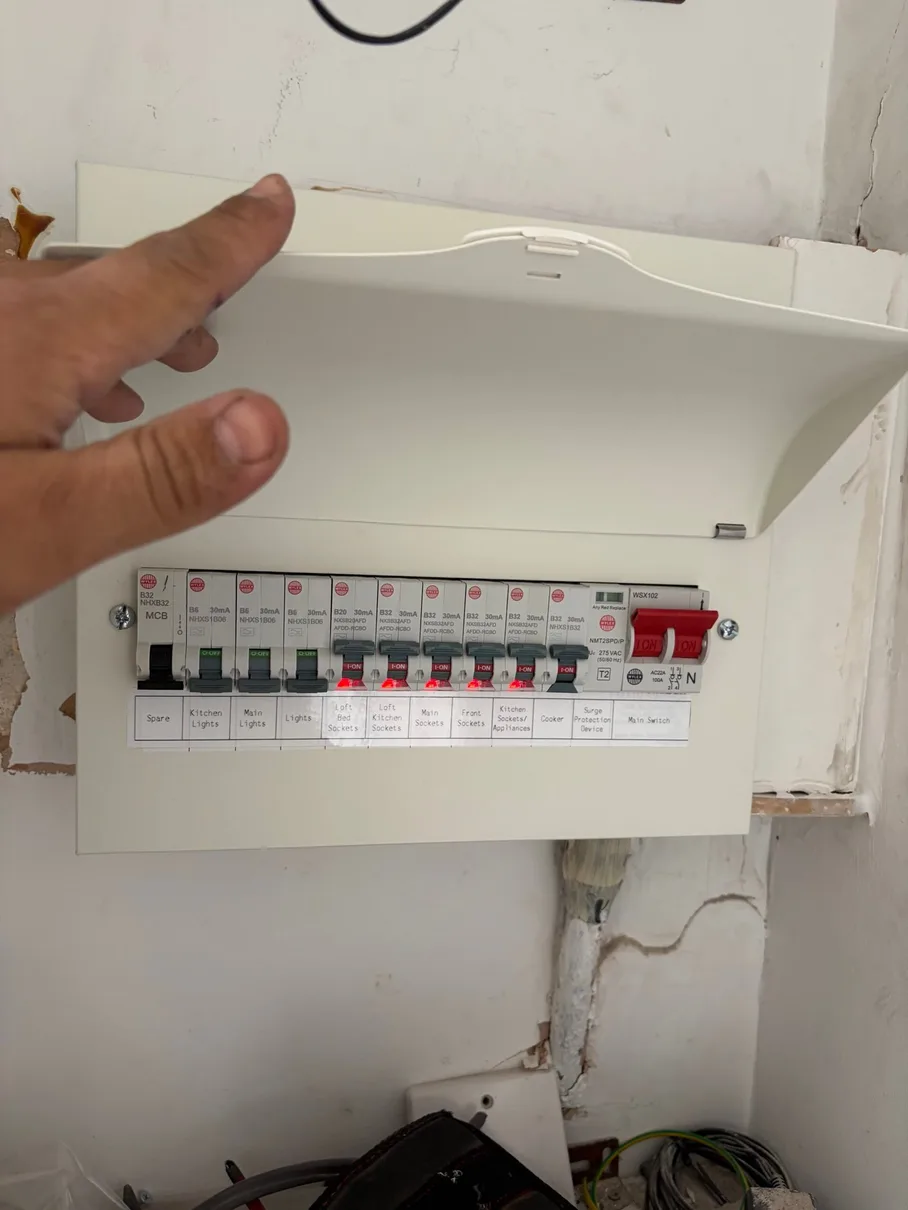
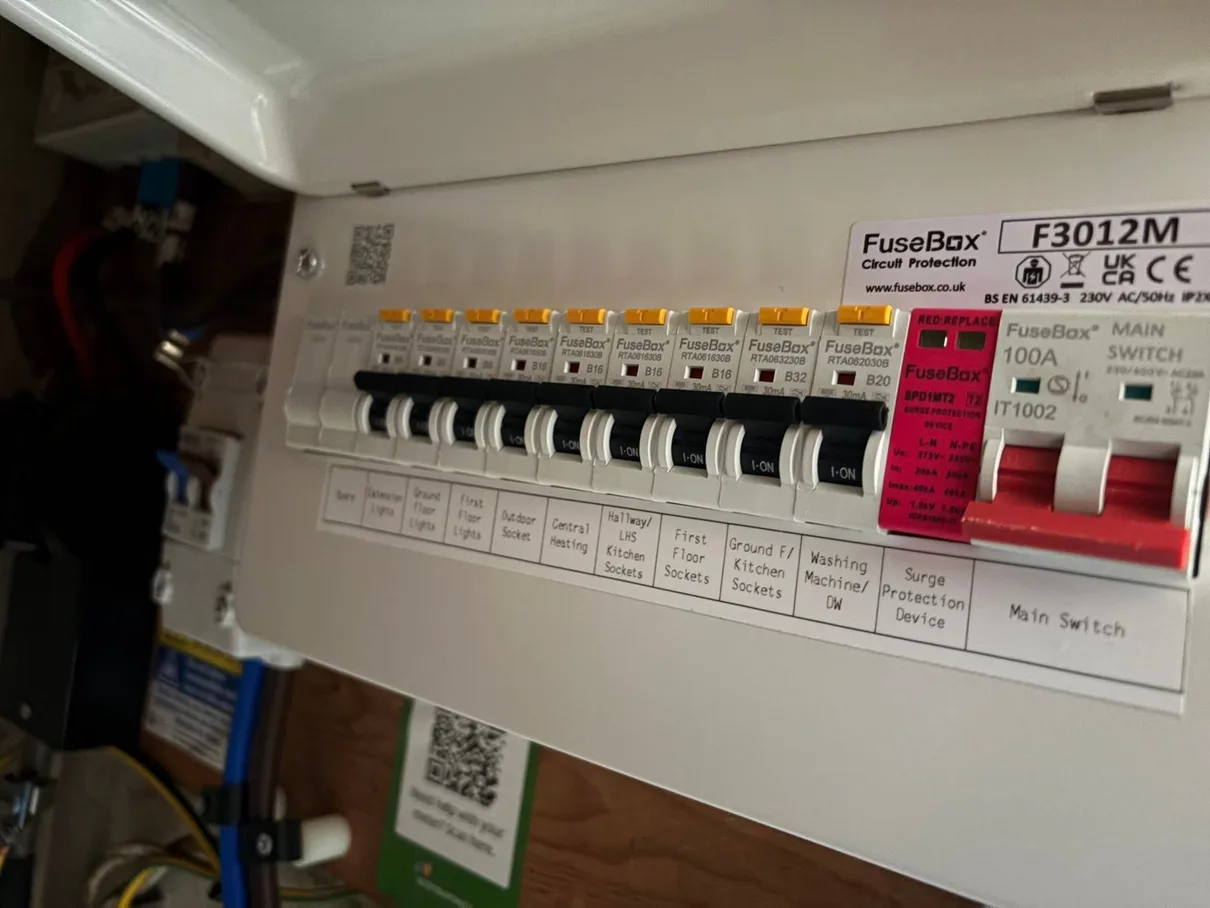
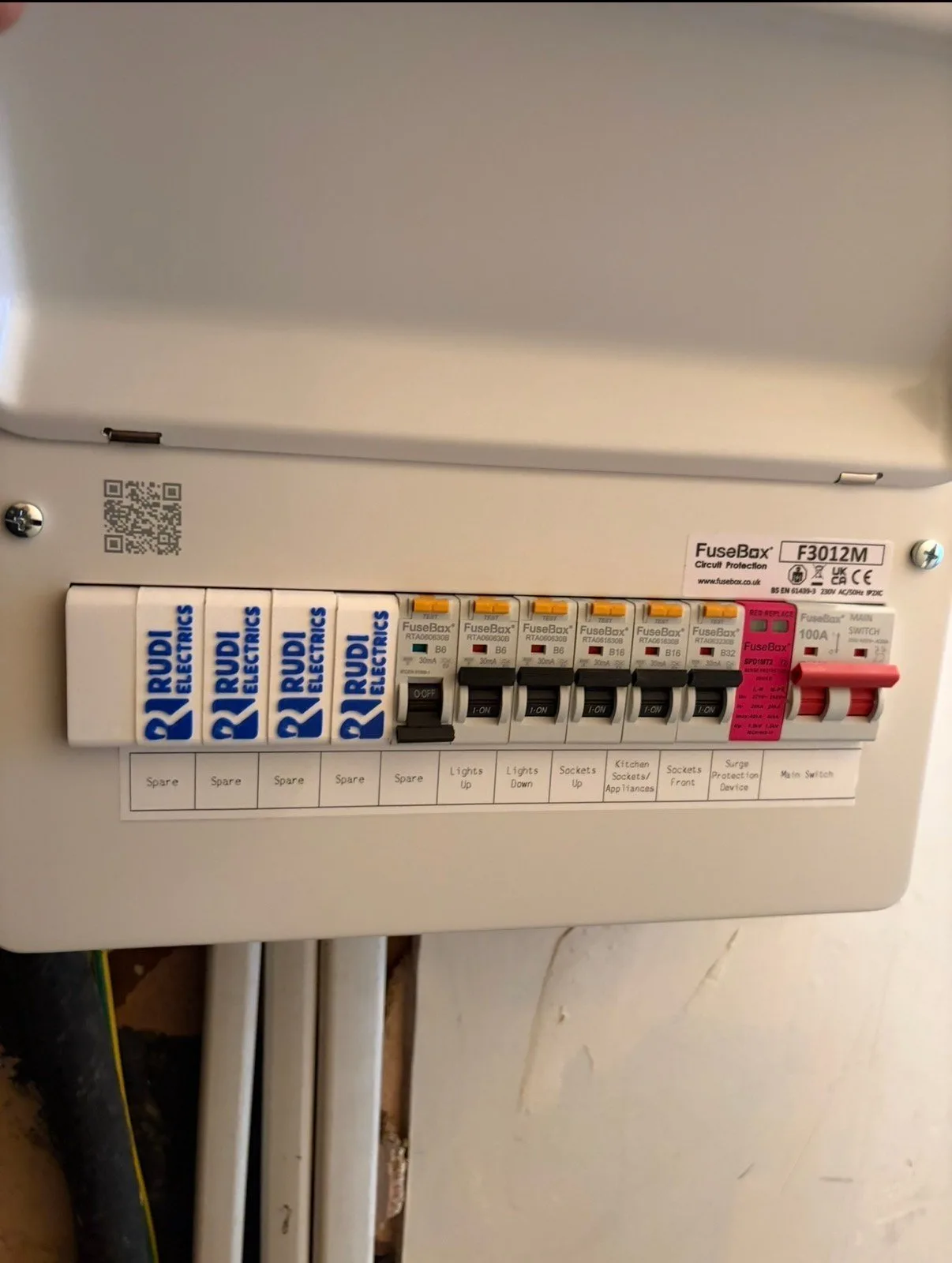
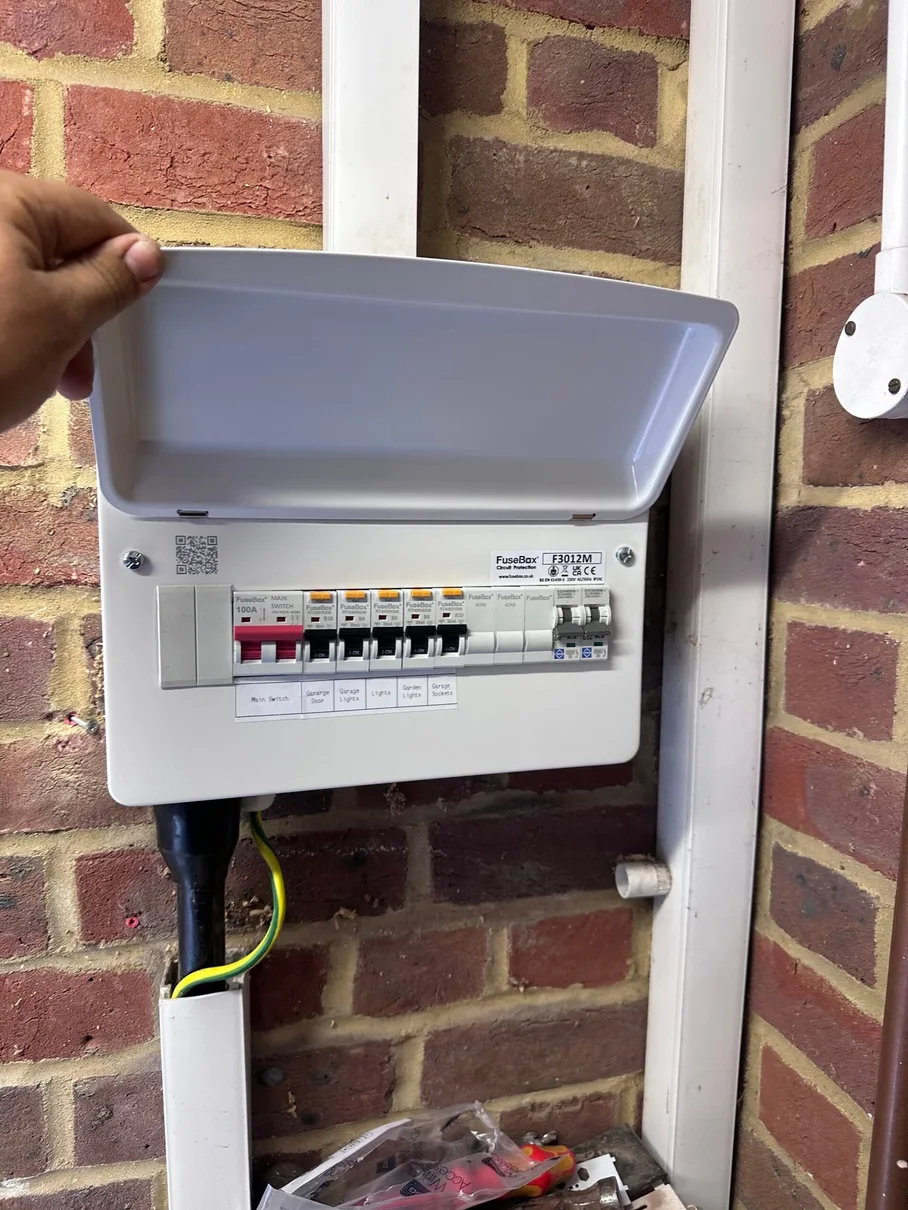
These completed installations come from the wider Rudi Electrics North London portfolio. They show the labelling, coordinated protection and tidy finish brought to consumer-unit work in Winchmore Hill; the specification at any Winchmore Hill N21 address still follows its own circuits and test results.
Swipe through installation details01 / 04
Installation 01Information that remains usefulA clear handover helps the household understand which circuit has operated and what it supplies.Installation 02A schedule tied to the circuitsLabels are produced from identification and testing, not copied blindly from the old board.Installation 03Protection selected as one systemThe main switch, circuit devices and surge protection are coordinated around the installation found.Installation 04A defined external supplyOutbuildings are treated as part of the electrical design, not as an unexplained extra cable at the main board.
From a Winchmore Hill enquiry to a usable handover
A controlled sequence for the tested property.
The six-stage process stays consistent. The information inside it changes with the Winchmore Hill address, access and circuit results.
Swipe through the installation process ← →
01
Read the property history
We discuss Edwardian and early 20th century properties, previous electrical work and how the “Multi-Storey Period Homes” context may affect the present circuit schedule.
02
Map the connected circuits
At 1930s detached and semi-detached homes, the “Loft Offices and Upper Bedrooms” context is checked alongside the supply, earthing, bonding and the real number of final circuits.
03
Plan access and isolation
Village Centre Flats & Conversions brings the “Flats Near Local Centres” context into the shutdown plan, with permissions or inaccessible areas recorded before the appointment.
04
Specify from evidence
For extended properties and garden rooms, the “Garden Rooms on Deeper Plots” context is considered with RCBO, surge-protection and enclosure requirements rather than sold as a fixed bundle.
05
Test before reconnection
Applicable BS 7671 tests show whether each Winchmore Hill circuit can be reconnected safely or needs a separately agreed repair.
06
Leave a useful record
The circuit schedule, certificate, notification where required and handover describe the Winchmore Hill installation actually completed.
A real-world situation we regularly see in Winchmore Hill
Edwardian & Early 20th Century Properties has changed since the old fuse-board schedule was written. What transfers safely?
Around Church Hill, Vicars Moor Lane, Compton Road, Highfield Road, The Grange, we regularly find that the “Multi-Storey Period Homes” context has changed how rooms or circuits are used, while the labels still describe an earlier layout. The circumstances differ from home to home, so tracing and testing come before the replacement decision.
01Trace
Around Church Hill, Vicars Moor Lane, Compton Road, Highfield Road, The Grange, we relate the old schedule to Edwardian and early 20th century properties and identify the circuits affected by the “Multi-Storey Period Homes” context.
02Test
For 1930s detached and semi-detached homes around Broad Walk, Hoppers Road, Manor Road, Wades Hill, Firs Lane, the “Loft Offices and Upper Bedrooms” context is considered with earthing, bonding and circuit results before any conductor transfers to RCBO protection.
03Agree
The written plan for loft conversions, rear extensions, garden offices separates the board replacement, the “Garden Rooms on Deeper Plots” context, genuine future provision and any repair revealed by the evidence.
A clear starting point
Fuse Box / Consumer Unit Replacement Pricing
Quick reference for Winchmore Hill homeowners. Fixed quotes given after a free site survey.
What remains after the visitClear identification makes the new board understandable to the Winchmore Hill household and to the electrician who tests it later.
Local survey knowledge for Winchmore Hill
What can affect a consumer-unit replacement in Winchmore Hill?
The final board, quotation and shutdown plan depend on the installation at the address. Across Winchmore Hill, Edwardian and early 20th century properties around Church Hill, Vicars Moor Lane, Compton Road, Highfield Road, The Grange and village centre flats and conversions around Winchmore Hill Broadway, Station Road, Green Dragon Lane, The Village can need different checks before the scope is agreed.
Around Church Hill, Vicars Moor Lane, Compton Road, Highfield Road, The Grange and Broad Walk, Hoppers Road, Manor Road, Wades Hill, Firs Lane, we look beyond the fuse box cover: the “Multi-Storey Period Homes” and “Loft Offices and Upper Bedrooms” survey contexts, together with the actual circuit schedule, can change what must be identified before replacement.
For the “Flats Near Local Centres” context around Winchmore Hill Broadway, Station Road, Green Dragon Lane, The Village, the survey gives access, isolation, protective devices and any separate circuit fault a written boundary instead of reducing a familiar neighbourhood property to a standard package.
The Winchmore Hill survey principle
Use familiarity with the “Garden Rooms on Deeper Plots” context around loft conversions, rear extensions, garden offices to recognise the likely questions; use test results from the property to answer them.
Four Winchmore Hill property contexts
Property details that change the board plan.
The streets and local centres below locate familiar property contexts around Winchmore Hill; they help us ask better questions, while tests at the address decide the technical answer.
Explore the four property contexts01 / 04
01
Edwardian & Early 20th Century Properties
Church Hill, Vicars Moor Lane, Compton Road, Highfield Road, The Grange
Survey focus: “Multi-Storey Period Homes”. Around Church Hill, Vicars Moor Lane, Compton Road, Highfield Road, The Grange, we check how it affects the existing circuits in Edwardian and early 20th century properties instead of assuming the answer from the postcode.
Question at surveyAround Church Hill, Vicars Moor Lane, Compton Road, Highfield Road, The Grange, what must the survey establish for Edwardian and early 20th century properties when “Multi-Storey Period Homes” is the planning focus?
How it changes the plan
We trace the real circuit count, existing loading and previous alterations serving Edwardian and early 20th century properties. The enclosure and protective devices then follow the evidence recorded under “Multi-Storey Period Homes”, not the number of labels or empty ways visible on the old fuse box.
02
1930s Detached & Semi-Detached
Broad Walk, Hoppers Road, Manor Road, Wades Hill, Firs Lane
Survey focus: “Loft Offices and Upper Bedrooms”. Around Broad Walk, Hoppers Road, Manor Road, Wades Hill, Firs Lane, we check how it affects the existing circuits in 1930s detached and semi-detached homes instead of assuming the answer from the postcode.
Question at surveyAround Broad Walk, Hoppers Road, Manor Road, Wades Hill, Firs Lane, what must the survey establish for 1930s detached and semi-detached homes when “Loft Offices and Upper Bedrooms” is the planning focus?
How it changes the plan
Pre-change tests establish whether the circuits serving 1930s detached and semi-detached homes can transfer cleanly to individual RCBO protection. Any borrowed neutral, insulation fault or unidentified conductor relevant to “Loft Offices and Upper Bedrooms” is explained and scoped before the transfer plan is confirmed.
03
Village Centre Flats & Conversions
Winchmore Hill Broadway, Station Road, Green Dragon Lane, The Village
Survey focus: “Flats Near Local Centres”. Around Winchmore Hill Broadway, Station Road, Green Dragon Lane, The Village, we check how it affects the existing circuits in village centre flats and conversions instead of assuming the answer from the postcode.
Question at surveyAround Winchmore Hill Broadway, Station Road, Green Dragon Lane, The Village, what must the survey establish for village centre flats and conversions when “Flats Near Local Centres” is the planning focus?
How it changes the plan
We confirm who controls isolation, which parts of village centre flats and conversions must be reached and how the access considerations under “Flats Near Local Centres” affect the people or equipment relying on the supply. The expected shutdown is then tied to that checked access plan.
04
Extended Properties & Garden Rooms
loft conversions, rear extensions, garden offices
Survey focus: “Garden Rooms on Deeper Plots”. Around loft conversions, rear extensions, garden offices, we check how it affects the existing circuits in extended properties and garden rooms instead of assuming the answer from the postcode.
Question at surveyAround loft conversions, rear extensions, garden offices, what must the survey establish for extended properties and garden rooms when “Garden Rooms on Deeper Plots” is the planning focus?
How it changes the plan
The final schedule for extended properties and garden rooms separates circuits already connected, specifically agreed provision and spare ways that are genuinely unused. Requirements recorded under “Garden Rooms on Deeper Plots” appear in the written scope and handover rather than being implied by a generic larger board.
Nearby Areas We Cover Around Winchmore Hill
We cover these four areas close to Winchmore Hill as part of our wider Enfield consumer-unit service.
01Can you do a fuse box upgrade without disturbing original cornicing or Winchmore Hill's listed features?+
Yes — Winchmore Hill N21 has substantial Edwardian and pre-war stock around Winchmore Hill Green, The Green, and Station Road with original cornicing, picture rails, and feature plaster. The fuse box itself is a meter-cupboard job, so no impact on internal period features. The constraint is cupboard size on some 1900s-1920s properties — meter recesses are tighter than standard and we sometimes specify a slimmer-profile board rather than the standard 14-way unit.
02I'm in Winchmore Hill conservation area — does the upgrade need conservation officer consent?+
Yes for visible alterations, no for the board itself. Winchmore Hill conservation area covers the streets around Winchmore Hill Green and parts of The Green. Internal fuse box replacement doesn't require consent. Anything externally visible — repositioned tails, surface conduit on the front elevation, new external isolator — does. We submit a written notice with material spec to Enfield's conservation officer before any visible run; typical turnaround 1-2 weeks.
03Lath-and-plaster walls in my Winchmore Hill house — how do you route cable without chasing?+
Upstairs walls in most Winchmore Hill Edwardians are lath-and-plaster on timber studs; some downstairs reception rooms still have original plaster cornice and picture rails. We don't chase into either. Cable runs go via floor voids and existing service penetrations. Loft routing is usually accessible; we drop down through voids above each switch position rather than across a wall. Where a particular run isn't achievable we walk the alternative with you before pulling cable.
04What's the difference between RCD and RCBO consumer units? Which one do I need?+
Both protect against electric shock and electrical fire. The difference is granularity.
RCD consumer unit (typically dual-RCD): Two big trip switches, each protecting a group of circuits. If one circuit faults, the whole RCD group trips — you lose the kitchen, lights, and sockets together.
RCBO consumer unit (one RCBO per circuit): Each circuit has its own combined trip switch. If the kitchen socket faults, only that circuit goes off — the rest stay live.
Why we recommend RCBO for most Winchmore Hill installs:
Faster fault diagnosis — you know immediately which circuit is faulty
Less disruption — one bad iron doesn't kill the whole upstairs lighting
Better with modern electronics — RCBOs are more sensitive and reliable
When dual-RCD is fine: small flats with simple circuit layouts, properties on a tight budget, short-term landlord-let where cost beats convenience.
Cost difference: typically £150 between dual-RCD (£800) and full RCBO (£950). For most homeowners we recommend the RCBO upgrade — it pays for itself the first time a fault localises rather than killing half the house.
05Do I really need a metal consumer unit, or is a plastic fuse box OK?+
This is the most common scare we see in Winchmore Hill — the fear-driven upsell to landlords.
Honest answer: plastic fuse boxes fitted before 1 January 2016 are still legal and don't automatically fail an EICR. They were the standard at the time of fitting. They become a problem only when:
The plastic enclosure shows signs of overheating or burn marks (genuine C2)
The board has no RCD protection on socket circuits (the fail reason isn't the plastic — it's the missing RCDs)
The original installation was non-compliant when fitted
Since 1 January 2016, all new consumer units in domestic properties must be made of non-combustible material (typically metal). This is a forward-looking requirement — your existing plastic fuseboard doesn't get retrofitted just because the rules changed for new installs.
What you should worry about: not the colour of the box. Worry about RCD coverage, the age of the wiring, whether the existing fuse box has been properly maintained, and whether your EICR has C1/C2 codes against the consumer unit specifically. If an electrician quotes you for "a metal consumer unit because plastic fails EICR" without that nuance — get a second opinion.
06Original Victorian wiring with cloth insulation in my Winchmore Hill property — can you keep any of it?+
Cloth-insulated VIR wiring in a Winchmore Hill Edwardian is end of life. The fuse box upgrade scope doesn't include rewiring, but during testing VIR circuits will fail insulation resistance and get a C2 code. We quote separately for the affected runs. Where the cloth wiring is a short final feed to an original wall light on a feature wall, we sometimes extend from a junction box with modern cable rather than full strip-out — preserves the surrounding plaster.
07Will my old wiring still work with a new fuse box?+
Almost always yes. The new consumer unit is the brain; your existing circuits are the nervous system. We connect to your existing circuit cables — they don't get rewired.
What we test before we commit:
Insulation resistance on every circuit (must be at or above 1MΩ; healthy 1990s+ installs typically read above 200MΩ)
Earth continuity — needed for RCD/RCBO to work safely
Loop impedance — the circuit's ability to clear a fault
If a circuit fails any of these tests, we tell you before we commit. Options:
Single circuit fix (£100-£300) — repair the fault and continue
Targeted partial rewire of just that circuit (£300-£600)
Hold the upgrade and discuss whether a partial or full rewire is now better value
Common Winchmore Hill scenarios where wiring fails: 1950s-60s rubber-insulated cable in upstairs lighting circuits (Vicars Moor Lane and Compton Road period properties), borrowed neutrals from DIY work, undersized cables on extension circuits.
We never "just power it back up" with a circuit that failed testing — that's how fires start. Honest tradeoffs only.
08I've been quoted £800. What if extra issues come up during the install — does the price go up?+
Honest answer: the £800 is fixed for the standard scope. Any extras are quoted upfront, never sprung on you mid-install.
What's covered in £800 (no surprise add-ons):
The new consumer unit / fuse board (quality metal, 6-10 ways)
RCD protection on socket and lighting circuits
Re-terminating every existing circuit, properly labelled
Full insulation, earth, and RCD testing on every circuit
The Electrical Installation Certificate (EIC)
Plaster patching with bonding plaster around the install
What CAN add to the price (we tell you before we start, with a fixed quote):
Circuits failing insulation testing — we'll show you the readings, and you decide: targeted repair (£100-£300 per circuit) or hold the upgrade for a partial rewire conversation
Incoming supply needs upgrading — rare; happens when adding heavy load like an other high-load equipment or heat pump. We tell you upfront if your supply is borderline
You opt for the premium tier — £950 (RCBO every circuit + surge protection) or £1,200+ (larger split-load board)
What we never do: discover a "problem" mid-install and charge you for it without your sign-off first. If we find something during testing, work pauses until you've decided. No scope creep.
09Are surface conduit options available that won't ruin a Winchmore Hill period interior?+
Yes — for Winchmore Hill period properties we use conservation-grade conduit when concealed routing isn't possible. Steel or aluminium in matt black, oxide-finish copper, or hand-painted to match the wall — never standard white PVC. Sized and positioned to look like a service run rather than a retrofit. Enfield's conservation officer approval is submitted with material specs before any visible run starts. Approval window typically 1-2 weeks.
010How do you handle main bonding upgrades where the existing pipework is original to the Winchmore Hill property?+
Winchmore Hill Edwardian properties often have original copper gas service and sometimes original lead water service still in place. Main bonding goes from sleeved copper bonding clamps at each service entry to the main earthing terminal via floor voids or existing penetrations — not chased into period plaster. Where the gas meter sits in the original under-stair cupboard or basement, the bonding run is short and concealed. Listed-building consent generally isn't required for non-listed conservation properties.
011Will the new consumer unit be ready for an other high-load equipment, heat pump, or smart home?+
Yes — and we set up Winchmore Hill consumer units for it as standard. What we include:
Spare 32A way on the fuseboard, labelled and ready for a 7kW or 22kW dedicated high-load circuit installation
Adequate supply headroom — we check your incoming supply and tell you upfront if a heat pump or other high-load equipment needs a supply upgrade (often the headroom is fine, but worth confirming)
SPD (surge protection) on the premium tier (£950) — protects every modern electronic in the house from voltage spikes
Smart-home-ready circuits — neutrals to switch positions if you specify (most period houses don't have these, blocking smart switch installs later)
What gets retrofitted later costs more. Adding extra circuits to an existing fuse box later — chasing walls, lifting floor coverings, isolating the supply again — is more disruptive and costs more than specifying spare ways during the consumer unit upgrade itself, which is marginal cost only.
Tell us at the survey stage what you might add in the next 5 years — future high-load equipment, heat pump, hot tub, garden room, second other high-load equipment, home office. We size the board around your plans, not just your current circuits.
012Will the consumer unit upgrade damage my walls or decoration?+
Almost never. Unlike a rewire, a consumer unit replacement is contained to the meter cupboard — usually under the stairs, in a hallway recess, or in a kitchen cupboard. The work stays in that one spot.
What we do during the install:
Disconnect existing circuits at the old fuse box, label every cable
Remove the old fuseboard from its mounting point
Mount the new consumer unit in the same position (same screw holes where possible)
Re-terminate every circuit into the new board
Test, certify, and label every circuit on the new unit's chart
What we don't do:
Chase walls
Lift floorboards (unless an existing cable is too short to reach the new connection point — rare)
Disturb skirting, sockets, or switches anywhere else in the house
Affect any decoration outside the meter cupboard
The only plaster work: if the new board is a different physical size than the old one, we may need to patch a small area of bonding plaster around the mounting position. That's included; finishing coats and any decoration are a decorator's job.
Winchmore Hill properties with the original fuse box in a tight under-stairs space sometimes need a little extra work to fit a wider modern board — we'll show you the position before we start so you can decide whether to keep it where it is or relocate.
Separate the decisions
Check the need, the protection and the price before you approve it.
The person discussing the survey remains accountable for the finished detail.
“I use the Winchmore Hill property context to prepare for the survey, but I want the circuit tests and written scope to justify every part of the recommendation.”
Rudi — NICEIC-Registered Electrician
NICEIC registration D609991 (verify) · 15+ years’ experience working across North London. Completed work carries a 12-month workmanship guarantee.
Start with the actual Winchmore Hill property
Show us the existing board. We’ll identify the next step.
Send the Winchmore Hill N21 address, a clear photograph of the consumer unit and the reason you are considering work. We will explain whether that is enough to advise or whether a free survey should come first.
Local neighbourhood context without a standard package
Visible access and shutdown details agreed in writing
Testing and certification matched to the completed work
Thanks — we’ll respond during working hours to discuss the existing installation and the most useful next step.
Your privacy choices
We use anonymous totals to improve this website. Optional analytics add fuller insights only with your permission. You can accept optional cookies, reject them or choose by purpose. See ourPrivacy & Cookie Policy.We count anonymous site totals. Optional analytics runs only with permission.Privacy policy.
Necessary
Required for security, enquiry forms and remembering your privacy choice.
Always active
Declining optional cookies or anonymous measurement does not affect the website or enquiry forms.